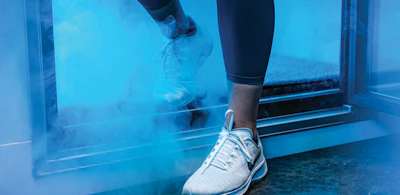
The end of a workout used to involve a cold drink of water, a shower and maybe some stretching before gymgoers or athletes would jump to their next task of the day. But times have changed, and now research has shown that thoughtful, intentional recovery can not only help the body respond better to the day’s workout, but it can have long-lasting effects, as well. Today, the end of a workout might see athletes stepping into a cryotherapy chamber for a few minutes, dipping into a cold plunge or spending a quiet half hour in a sauna.
Modern recovery professionals know that neither cardio nor strength alone lead to peak athletic success without proper recovery. The whole athlete needs all three fitness components — cardio, resistance and recovery — to build a strong body.
“How hard I work is important, but how hard I rest is equally important,” says Edward Navan, wellness product manager at Precor. “If you recover better, your workouts are better.”
For Adam Annaccone, co-chair of the National Athletic Trainers’ Association’s Sports Science and Data Analytics Task Force, it is about more than just building a better workout. The focus on recovery is also key to injury prevention and keeping athletes training at a high level.
“I think [recovery] speaks to my philosophy that I’ve always had, looking at this holistic view of individuals and optimizing performance within a safe and effective manner to mitigate the risk of injury,” says Annaccone.
Recovery in high school, college or professional settings can often fall to the athletic trainer for implementation, because proper recovery leads to injury prevention.
“The athletic trainer can easily interject and provide resources or tools to aid recovery,” Annaccone says. “I think it falls into athletic training because of the risk-mitigation and injury-mitigation pieces of it. We obviously want to make sure that no one is getting hurt, and if they do, we know what to do and want to mitigate risk as much as possible.”
Annaccone adheres to four main pillars of recovery: sleep, nutrition, hydration and stress management. “Recovery doesn’t have to be expensive,” he says. “I certainly think that you can achieve recovery regardless of how much or how little money you spend on it.”
Going back to the basics can be a great starting point for individual athletes or fitness enthusiasts, but for larger teams and organizations, it is essential to provide clients and athletes with the necessary means to achieve recovery — from suitable spaces and modalities to knowledgeable staff. It can be an intimidating new frontier.
That said, two primary options offer athletic trainers, teams and fitness centers an accessible entry point in terms of implementation and programming: heat and cold.
Infrared vs Red Light: What's the Difference?
Red light works on a cellular level, improving cellular regeneration and surface-level appearance.
Infrared therapies work on a larger scale, relieving muscle soreness and reducing overall inflammation.
Both help the body recover and are often used in similar modalities.

Heat
Heat has been one of the most common recovery modalities on the market. Despite a decades-long history of saunas in fitness centers and professional team locker rooms, Precor’s Navan understands that “the industry as a whole is a little bit lost on what recovery and optimization really are.”
“We’re very early in the learning curve, so it is a unique opportunity to do some cool things,” he says. “Precor realized that the gym itself — the experience — is evolving. It’s not just about having more treadmills, more ellipticals and more chest presses. It’s about attracting that new consumer demographic, and keeping the one you have healthier longer.”
Precor has long offered commercial-grade saunas, and recently the team added infrared and red light therapies to its recovery lineup. Says Navan, “Precor is definitely an early adopter in terms of understanding the power of the sauna and red light therapy.”
Due to the popularity of the sauna as a recovery tool, Precor offers multiple varieties to fit any facility’s needs, from the classic single- or double-occupancy models to larger saunas for social wellness and beyond.
“We also have a sauna that you can actually exercise in. The benches get removed, and you can do spinning, rowing, ski erg and band work,” Navan says. “I think you’re going to see saunas become more prevalent in programming inside these gyms, as well.”
Along with its classic saunas, Precor has also made a push into the red light recovery modality. “Red light products, no pun intended, are the hottest thing out there right now,” says Navan.
That trend is also in line with what Annaccone has seen in the recovery space as a whole. “There’s a really big push on infrared saunas and float tanks,” he says. “There’s a push on laser therapy and shockwave therapy that promises to rejuvenate tissue faster.”
Infrared, as Navan describes it, heats the body like a microwave — from the inside out. “It’s all about improving cellular health,” he says. “As we age, our cells tend to not produce as quickly. Red light is basically like charging your cell phone every night. By putting your body in a red light bed or booth, you are recharging that body, that cellular network.”
Light therapy can also be combined with several other modalities for a streamlined approach to recovery. Says Navan, “With red light, whenever you add heat to it, you’re doubling that effect and getting a much better overall experience. You improve circulation, cellular uptake and healing.”
For Navan, these cutting-edge recovery modalities have gained a strong foothold due to social media and the rising popularity of “biohacking.” Gymgoers and elite athletes alike may see a recovery trend on social media and request it at their training facilities or fitness centers as a result.
“Everything moves at the speed of social media,” says Navan. “There are a lot of influencers out there right now pushing red light and home saunas, and I think that right now the biggest influencer out there is social media.”
That means that fitness centers that are just “checking the box” aren’t going far enough to meet customer demand or expectations. It isn’t enough for a fitness center to tell clients they offer cold or heat recovery services. Clubs must consider the design, even the lighting, of the recovery space.
“I think clubs rush to the space, but they need to step back and ask, ‘How do I program this?’ ‘How do I design this?’ ‘Do I want to monetize this?’ ‘Do I want it to be more of a membership benefit?’ ” explains Navan. “It’s getting really interesting, because these items are costly. This technology is not cheap. You can’t just put one item in and expect it to work.”
That said, fitness centers and teams alike have more than heat-based modalities to invest in and program around. The opposite end of the spectrum is just as important.
“We have a tendency to like extremes,” says Navan. “I want the coldest of cold, the hottest of hot.”
 Photo courtesy of CryoBuilt
Cold
It may surprise recovery seekers to hear Mindy Bonner, director of sales and revenue at CryoBuilt, say, “There is no such thing as cold.”
Dig a little deeper, and Bonner explains that cryotherapies create astounding negative-150-degree temperatures by removing heat and energy from the atmosphere, similar to the way an air conditioning unit or refrigerator operates. The absence of heat leads to the frigid temperatures found inside the chamber. Bonner describes CryoBuilt’s innovation process as a combination of refrigerants that are compressed and moved through pipes to remove the heat from the chamber and disperse it into the environment.
“We have a secret recipe for that,” says Bonner, including a formula for wind chill that the team adopted from NASA.
Bonner also dispells any concerns of frostbite among wary cryotherapy newbies, noting that frostbite usually occurs because of a combination of moisture and speed of decreasing skin temperature.
“Water is conductive and the wind chill causes it to be felt as even cooler, pushing heat away from your skin. That will cause frostbite,” she says. “Typically, that takes a little bit of time.”
CryoBuilt started in industrial refrigeration, but pivoted to the cryotherapy business in 2020 with the launch of Everest, the company’s flagship cryotherapy chamber product. Fellow cryotherapy company, CryoPhit-USA, followed a similar path — transitioning from pharmaceuticals and biotech to cold therapies.
“We took proven ultra cold technology and adapted it for safe, accessible and performance-focused recovery,” says Matt Butera, the company’s managing member. “That collaboration led to the creation of CryoPhit-USA.”
“The whole wellness industry is taking off,” says Bonner, citing 2020 as a pivotal year. “Some of our first clients were professional sports teams, and there were the colleges that followed. The larger gyms were looking for a way to differentiate themselves.”
The same trends were evident to Butera’s team at CryoPhit-USA. “We’re seeing strong growth in three client groups,” he says, pointing to wellness clients, adult high-level athletes and even youth athletes.
So why would a gymgoer or high-level athlete subject themselves to three minutes of freezing temperatures?
“The thought process behind it is that you trick the body into thinking it’s freezing to death and so it’s going to pull all the blood to the major organs, and then the blood gets re-oxygenated and pushed to the extremities,” Annaccone explains.
“Cryotherapy has become one of the core components of modern recovery routines,” adds Butera. “Cryotherapy supports improved circulation, reduces inflammation, eases general soreness, boosts energy, and helps clients feel refreshed and ready for their next activity. It also allows active individuals to bounce back more quickly between workouts or training sessions.”
The cold pros can all attest to the rising trend in recovery as a whole, and for facilities considering adding cryotherapies to their lineup of recovery options, Bonner notes that while the equipment may come with a high price tag, ongoing operation of a cryotherapy chamber doesn’t have to cost a fortune.
“It’s very easy to maintain the temperature throughout the day due to the way we’ve engineered those parts,” she says. “Even with high session usage, we’re not using more than five kilowatt hours” of electricity.
That accessibility has been key in growing cryotherapy beyond the professional sports locker room. “It was big when I was in [pro sports],” Annaccone says. “Now, you can go down the road to a health and wellness center and hop into a cryochamber.”
“We’re seeing growth in other areas,” says Bonner. “The professional teams are absolutely still growing in that arena, but athletic clubs and gyms are” growing, as well.
The investment in cryotherapy for teams and gyms is not the first time that cold-based recovery modalities have been used in the locker room. Before gymgoers and athletes stepped into -150 degree chambers, they were plunging into icy waters. Cold plunges provide sustained exposure to waters ranging from 45 to 55 degrees and achieve similar results for reducing inflammation and muscle soreness.
It may take time for the latest cold therapies to reach the same level of notoriety as heat-based recovery modalities, but those immersed in the recovery space can see that both extremes are necessary for a well-rounded approach to recovery.
“Many clients view cryotherapy as the centerpiece of their weekly recovery routine,” explains Butera, who sees providers “adding services like heat therapy, stretching, red light therapy and compression around it for a more complete recovery experience.”
 Photo courtesy of CryoBuilt
From hot to cold, recovery is the fastest-expanding frontier in fitness, and these experts can attest that facility owners and team athletic trainers are making recovery a focal point in the new year. Especially for the gymgoers or new users in a facility with a “New Year, New Me” attitude, recovery can be key to enhancing — even extending — their fitness experience.
Says Bonner, “Activity is necessary, but getting into activity isn’t always the easiest. If you have been sedentary and not moving around so much, you need something to help improve the aches and pains so you can continue on your journey into fitness.”
That may describe many new members at any level of fitness and recreation, from the college rec user to private fitness clubs.
For any facility looking to add new recovery modalities and wondering how to educate users on the importance of recovery, Annaccone puts it best. “If you live longer, is it worth it if you’re not living better? And I think that answer is absolutely: no,” he says. “It’s a matter of enhancing that quality of life.”
The Case for Wearables
Adam Annaccone, co-chair of the Sports Science and Data Analytics Task Force for the National Athletic Trainers’ Association, has witnessed recovery’s arc from haphazard to essential over the course of his athletic training career, which put him in front of athletes at all levels.
While some trends have come and gone in the recovery space, there’s one fact that Annaccone can’t ignore: “Right around the time that recovery got big, wearable technology got really big.”
Wearable technology — in the form of rings, heart rate monitors or smart watches — collects data on a person that can be used to track fitness progress and health.
“Wearable technology is certainly starting to fall into this realm of recovery,” says Annaccone. “How can we use data to objectify where somebody is at in that moment in time and make a decision as to whether they had enough load placed upon them or not enough load. Do we need to modify based on data?”
“Training intensity has increased, making proper recovery essential for maintaining performance,” adds Matt Butera, managing member of Cryophit-USA. “Wearable technology now highlights the impact of good recovery habits, giving athletes more awareness. Many professional athletes openly share their recovery routines, influencing athletes at all levels. There is also a growing emphasis on staying active longer and reducing downtime from overuse or strain.”
Edward Navan, wellness product manager at Precor, envisions a totally interconnected fitness center, where in-house staff or athletic trainers can advise on gymgoers’ most-needed recovery modality based on the data from their wearable technology. For example, he postulates that staff could analyze data from a gymgoers’ lifting or cardio session, then direct them to either a sauna or cryochamber based on the load on their body and estimated recovery needs.
These wearable devices are accessible to anyone, not just professional athletes or college athletes who work with teams of athletic trainers. Says Navan, “I’m excited to see how that becomes a part of the infrastructure of programming in health clubs in the next two to three years.”