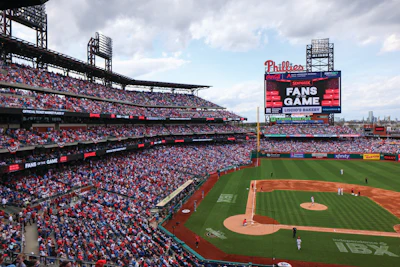
Athletic Business recently caught up with some of the leading experts in the scoreboard and video display industry to solicit their perspectives on where the technology is headed and how venues of all sizes are adapting to rapidly evolving fan expectations. From fine-pitch LED advancements to AI-powered content creation, these industry veterans reveal how the gap between professional and high school installations is narrowing, which purchases athletic directors are prioritizing and which emerging technologies will reshape gameday experiences over the next five years.

Smaller pixels, bigger impact
The most significant technological shift in the industry centers on pixel pitch — the measurement in millimeters between the centers of adjacent LEDs. This seemingly technical specification is fundamentally transforming what venues can deliver to fans.
“Fine-pitch LED technology is revolutionizing the quality of indoor and outdoor displays,” says Jeff Morgan, sales director for Sports & Indoor at Watchfire. “With pixel pitches as small as 0.9 millimeters, these displays deliver dramatically sharper images, even from close distances. This allows venues to install screens that look crisp whether fans are on the sideline or in the upper deck.”
Tac Doran, video display consultant and project manager at Colorado Time Systems, says natatorium video board pitches can go even smaller, noting that the pace of change in the industry has been remarkable. “Two years ago, most would consider the standard pitch for an indoor aquatics venue to be an 8- or 10-millimeter pitch display,” he explains. “Now, we are seeing many requests for 6 millimeters and below. Non-aquatics venues are pushing into the sub-2-millimeter pitches on a regular basis.
“With display pitch shrinking, it really means that overall fan experience is vastly improved by the higher resolutions. These tighter pitch displays mean that venues can push more data to a given size screen because that display now has so many more LEDs to render that information.”
Will Ellerbruch, national sales manager at Daktronics, notes the convergence of multiple technologies working in concert, pointing to “key technologies like Micro LED, Chip on Board, fine-pitch surface mount devices, higher-dynamic-range processing, higher refresh rates and improved driver/control electronics.”
While that may sound like technical mumbo jumbo, Ellerbruch says it all adds up to “crisper replays, truer colors, less visible pixel structure for close views and fewer maintenance interruptions — all combining to make fans feel closer to the action.”
 Photo courtesy of Daktronics
Interactive engagement
The days of scoreboards simply displaying the game clock and the teams’ scores are long gone. Today’s displays are becoming entertainment vehicles that engage fans in entirely new ways.
“Manufacturers are adding interactive features like touchscreen kiosks, mobile integration and LED floor graphics to create immersive fan experiences,” says Chris Kirn, president and CEO of Digital Scoreboards. “These technologies allow fans to engage with live stats, social media, games and sponsor content, which are turning scoreboards into dynamic entertainment hubs rather than just score displays.”
Morgan emphasizes the importance of making these capabilities accessible. “Scoring software that has built-in interactive features removes the friction of added equipment and training,” he says. “When live video, content zones, crowd prompts and statistics integration are just a button away, operators deliver more engaging experiences consistently and without the complexity.”
The technology is also expanding into new physical formats. “LED video displays are starting to take over in areas that used to be reserved for typical LCD monitors,” Doran says.. “LED video displays can be adapted with touch screen overlays that can allow multiple fans to interact with large displays concurrently. RFID proximity identification can provide fan-specific content and information that they want just by approaching a display in the venue.”
Ellerbruch also says interactivity is continuing to evolve, ranging from QR-driven activations to live polling and social media walls. “Fans want to participate in the story, not just watch it,” Ellerbuch says. “Interactivity turns passive viewers into active storytellers.”
 Photo courtesy of Watchfire
What ADs really want
When it comes time to make purchasing decisions, facility managers and athletic directors have evolved from simply seeking bigger and brighter displays to demanding comprehensive solutions that balance multiple priorities.
“Athletic directors and facility managers most commonly ask for systems that are easy to operate, even by non-technical staff, with intuitive software and mobile control options,” Kirn says. “They also prioritize strong warranties and responsive service support, knowing reliability is key during events. Multi-use functionality, such as using the display for assemblies and graduations, is another frequent request, helping schools and venues maximize their investment.”
The long-term nature of these investments makes reliability paramount. “Choosing a scoring and entertainment system is a 15- to 20-year commitment,” Morgan says. “Athletic directors and facility managers need future-proof solutions that perform as reliably in year 10 as on day one. They need systems that are upgradeable, meet evolving compliance requirements and integrate with tomorrow’s technologies.”
Ellerbruch confirms these priorities from Daktronics’ perspective. “Our top asks are reliability, ROI and ad monetization, brightness and readability in daylight, ease of operation, total cost of ownership, warranty and service and long product life.”
There’s also growing interest in phased implementation strategies. “I get asked about ‘starter packages’ almost every day,” Morgan says. “The concept is smart. You start with basic scoring at the scorer’s table, let the technology prove its value, and the sponsorship checks start rolling in, then add components season by season — videoboards, centerhungs and concourse signs. It’s the money-wise way to build a complete system without betting the entire budget upfront.”
The demand for multiple displays rather than single large installations represents another significant trend.
“As the price of video displays has come down dramatically, we are seeing more and more requests for multiple displays in a venue,” Doran says. “Facilities are realizing that having multiple smaller displays provides a much better fan experience than a single large display. It also gives them more freedom to dedicate content depending on where in the facility the display is located.”
 Photo courtesy of Digital Scoreboards
All levels of play
Perhaps one of the most surprising developments in the industry is how technological improvements have narrowed the gap between what can be achieved with display systems at different levels of competition.
“We believe the gap between professional, college and high school display requirements has narrowed significantly,” Kirn says. “The technology has improved so much that what works in a high school gym can now meet the standards of a professional arena. With high-quality, scalable products and flexible software, the same system can deliver pro-level performance across all levels.”
Morgan echoes this perspective. “Thanks to more affordable technology, I find fewer differences in scoreboard capabilities across competition levels,” he says. “Control room integration was once a D-I-only concern. Now we install high school packages with eight-camera replay systems and pay-per-view streaming.”
However, these experts are quick to note that differences remain — just not in ways the public would necessarily notice. “While some requirements remain level-specific, like a college’s need to integrate NCAA Live Stats, most differences are driven by goals rather than technical capabilities,” Morgan explains.
Those goals vary significantly by level. “Professional venues buy competitive advantages, choosing displays that create market differentiation and deliver measurable ROI that justifies premium investment,” Morgan notes. “College facilities buy recruiting tools and donor satisfaction, selecting scoreboards that enhance program prestige while generating enough revenue to be fiscally responsible. High schools purchase videoboards that serve multiple purposes, operate simply enough for volunteers, last season after season and pay for themselves through local sponsorships.”
Ellerbruch summarizes the tailored approach required: “We size pixel pitch, service level, control complexity and financing models to each market so the solution matches the use case and lifetime expectations.”
 Photo courtesy of Colorado Time Systems
AI as a practical tool
Artificial intelligence is everywhere and now making its way into scoreboard systems, though perhaps not in the dramatic ways one might expect. Instead, AI is proving most valuable in making professional-quality content creation accessible to venues with limited resources.
“AI is the great equalizer in sports production,” Morgan says. “A volunteer parent can now generate animated 3D mascots and motion graphics that rival professional work — no design degree required.”
Kirn also confirmed AI’s emerging presence in display technology. “Yes, AI is starting to play a role in scoreboard systems, especially in enhancing interactivity and immersion. Interactive plugins powered by AI are beginning to find their way into the industry, making displays more dynamic and personalized for each venue.”
The applications extend beyond content creation into operational efficiency. “The most transformative AI applications are the invisible ones, like improved search functions that instantly find the right graphic among thousands, crowd prompt systems that suggest the perfect moment,” Morgan explains. “AI isn’t just making content creation easier, it’s making the entire production process smarter.”
Ellerbruch says AI is enabling sophisticated operational capabilities at the enterprise level. “Practical, applied AI appears in predictive maintenance, automated content optimization, audience analytics, ad targeting and automated clipping and highlight generation,” he says, noting the benefits are tangible, offering “less downtime, smarter sponsor ROI, faster content creation and actionable crowd insights.”
A changing landscape
As these experts look toward the future, several clear trends emerge that will continue reshaping the scoreboard and video board landscape.
“In the next three to five years, we expect to see true interactive engagement between fans and LED displays where fans can influence what’s shown in real time,” says Kirn. “AI will play a bigger role in automating content and personalizing experiences, while 3D display technology is emerging as a visually stunning way to elevate gameday entertainment.”
Esports integration also looms large. “Esports is poised to become a true local spectator sport, played out on the big screen,” Morgan predicts. “During renovations and new construction planning, traditional sports venues will optimize video displays for hosting esports tournaments, with support for multiple game feeds, player webcams, chat overlays and sponsor ads.”
Morgan says operators may also need to closely oversee the content displayed in their facilities to ensure authentic content is reaching the consumer. “I believe fans will demand content authenticity. We’ve already seen how easy it is to be fooled by AI-generated videos, and as deepfake technology continues to advance, distinguishing real from fake will become even harder,” he says, adding that trust could erode quickly without proper safeguards. “Forward-thinking facilities will need to establish clear processes and standards to safeguard their content.”
As the industry continues its rapid evolution, technology’s ability to create engaging, immersive fan experiences at virtually any level of competition will remain constant. The challenge — and opportunity — for venues lies in selecting the right systems, partners and strategies to maximize both the fan experience and return on investment over the lifespan of these increasingly sophisticated installations.