
Where did you go to learn how to meditate?
I first started reading about it in books and articles, and then it was actually a research study that I had read. In this research study, these folks had done a meditation retreat and had all these benefits, and I was really curious at that point. The type of meditation that they’d done, they said, was largely taught for free in the United States. At this time, I was in my early 20s, and the free part sounded really good. So, I looked it up. I was living in Illinois, and found a local group, and they had a foundational course that you could take. I took it and never looked back.
What is the Center for Healthy Minds?
It happens to be the world-leading neuroscience research group investigating mental training and contemplative practice. I went from doing it out of my own curiosities to the big leagues, so to speak, and so it was incredible for me, because then I got to work with literally the best in the world in this sort of training. And then I got involved doing the work with a range of other populations — corporate health care, law enforcement and then athletes. That kind of segues into working with Wisconsin Athletics.
How did you come to be a full-time athletics department employee?
It’s a uniquely Wisconsin story, to be honest. I was working on campus at the Center for Healthy Minds with all these different populations. As a college soccer player, I always saw how this stuff could show up in sport environments, but I have an orientation of “don’t coach until you’re asked to coach.” An opportunity had emerged via my sister-in-law, who was working in a different college athletics department. I was just exploring a little bit with one of the teams that she was working with — just really out of curiosity and my own interests — and realized there’s some possibility here. Things really kicked into gear when Chris Borland, an All American at Wisconsin, retired from the NFL and wanted to do something for guys who’d played the game. He got in touch with the Center for Healthy Minds, and we got connected. Long story short, we created an eight-week mindfulness-based training for 17 retired NFL guys.
What were your expectations?
We didn’t know what would happen with these guys. Would these guys think it’s a bunch of hippy dippy woo woo? “What the heck are we talking about?” Some of these guys were a year out of the league. Some of the guys were 20 years out of the league. So we did this training, and guys found it rigorous. They found it beneficial.
Were these guys struggling in retirement?
That was not our motivation. We weren’t looking at it from kind of a pathology or deficit perspective. It was really that “strength and conditioning for the mind” perspective. How can we bring this training to this particular population to help them move forward from wherever they’re at? Of course, every individual has their own particular circumstances, but we weren’t trying to respond to the difficulty that was happening in their lives. It was more let’s give folks these skills — and it really is a skill-based training — that they can then bring into whatever’s happening in their lives. And some of these guys were still on staff at Wisconsin in the athletics department, so that sort of bridged into current athletes. They thought current student-athletes could benefit. One of those was the then-head strength coach for the football program. He said, “Hey, it would be great if we figure out a way to bring this into the football guys.” We just started to explore what that could be like, and it grew. It started small — again, from that place of curiosity of what it might look like, what the benefits might be — and then that was kind of the segue into to the athletic department.
Have other Division I athletic departments started to do what you’re doing?
It’s an interesting dynamic. I think one of the things is that there’s the overlapping field of mental performance — sports psychology. My particular area of expertise is mindfulness and meditation. I would say the work that I do is probably couched in a larger understanding of mental performance or sports psychology training. Sports psychology positions are very normal in major college sports and pro sports, and I think there are some unique things that are happening inside of a mindfulness-based approach. One of the conduits that we’ve been using to get at that is science, is research. For example, we published a paper last year that looks at the state of mindfulness in sport and exercise. What is the skillful development of somebody who wants to bring mindfulness and meditation into these performance environments? It’s an area where there’s lots of opportunity for growth in the field. It’s not clearly defined. There are more clearly defined roles in other spaces where mindfulness has shown up, including things like mindfulness-based stress reduction and mindfulness-based cognitive therapy. We’re trying to bring some of that into the performance space, as well.
You’re obviously valued by UW, but is it hard to put a value on what you do?
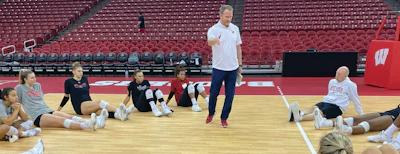
Probably to a certain degree, but we are able to do it in a variety of ways. We’ve published research on the benefits of it, so that’s as quantifiable as it gets. This particular research study, we saw increases for athletes in mood, energy level, muscle readiness, readiness to train. These are foundational performance factors and wellbeing factors, so we’re able to see it that way. And then we bring the work into an environment, and then collaborate with coaches, with teams. I have been embedded into the Badger volleyball program, and the Frozen Four with men’s hockey, and integrating the work there. And then we’re able to bring the work outside of my role at UW. I train in other environments, including still training in law enforcement and corporate environments. There’s kind of the cultural acceptability piece of mindfulness meditation — mental training, more broadly — that folks can say, “Okay, this is a performance advantage.” And it’s happening in groups where performance matters.
How do you define meditation?
The way I think we should think about meditation is it’s training the mind, and there are so many ways one could train the mind. I think here’s where the metaphor of strength and conditioning for the mind applies very well. Any of us could go to a weight room and we can train for power, speed, explosiveness, mobility. There are so many ways to potentially train the body, and it’s all under that umbrella of strength and conditioning for the body. So meditation is that umbrella. It’s the training of the mind. And one of the things that we can train the mind for is mindfulness.
How do you define mindfulness?
We need to differentiate when we say meditation and when we say mindfulness. These are two different things. They’re related, but they’re different. Mindfulness has a specific set of skills. From a neurocognitive perspective, these are three sets of skills that have to do with selective attention, having our attention be where we want it to be; meta awareness, or what we can think of as the eye of the hurricane, kind of a sense of stability and awareness while things are happening around us, or things are happening in us — thoughts, emotions — there’s the capacity to observe them and not get swept into them; and then there’s decentering, not believing every thought that comes through our minds.
How does this translate to sports performance?
Potentially in its relationship to something like visualization. The skills that we just talked about — having your attention be where you want it to be, having stability in external and internal experiences that may get very intense, and being able to not believe every thought that comes through — those become foundational to practices like visualization. Someone’s completely distracted, they’re not going to be able to do their visualization well. If someone’s completely swept into all their emotional reactivity, they’re not going be able to do their visualization well. And then it becomes not just a visualization thing, but this all becomes part of our life, right? If we have a sense of concentration in the midst of any environment, whether it’s a mental training practice or sport practice or sport performance, or in the case of college athletes, their academic lives, for all of us in our personal lives, they just become foundational skills that are domain general, and then we can apply them across all these different aspects.
Are there best practices for athletes — frequency or time of day — when it comes to training the mind?
That’s a very open question. We don’t have it buttoned up scientifically in that way. Honestly, the best answer is that the best time and the best length to do it is the one that you will actually do. The research here is pretty clear that consistency is a big predictor of good outcomes. Whether that’s 30 seconds or two minutes, or every other day, or woven into a dynamic warmup, there’s lots of creativity that we can have. Again, to go back to that strength and conditioning metaphor, if someone’s not doing much, and they start by walking around the block a couple times, that’s great. At a certain point, it can be dialed in depending on folks’ interests or needs or what they’re trying to develop. That’s my role — to help inform individuals how they go about that.