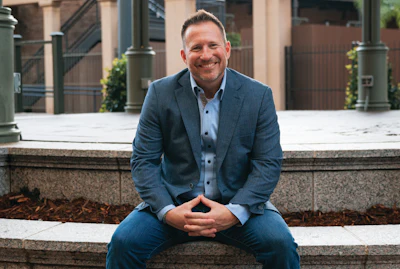
Chris Stevenson built his career from the ground up — literally. He opened a 2,000-square-foot personal training studio funded by his own savings, then grew it into a two-club operation he ran for 20 years, building a reputation on member experience above all else. That track record led to speaking, then consulting, and in October 2019 a regular column in these pages, “The Owners Club.” Today, Stevenson is founder of consultancy firm The Empower Group and co-author of the 2024 textbook “Fitness Facility Management.” This November, he adds a new credential: AB Show 2026 keynote speaker. Ahead of Orlando, Stevenson spoke with AB executive editor Andy Berg about the throughline connecting his club days, his column and the keynote stage.
How did you get into this industry?
A million years ago, I had a career outside of fitness but was looking for a different avenue, so I started teaching group exercise and personal training — very front-line, very in front of the people we serve in this industry. I fell in love with it, and from there went through a bunch of different roles, everything from sales to management, in all sorts of environments — commercial, corporate, franchise. Then the entrepreneur bug bit, and I opened a 2,000-square-foot personal training studio. I joke that I should be credited with starting the studio market, since this was before studios took off, but the truth is that 2,000 square feet and 10 pieces of equipment was all I could afford. We called it “the little gym.” We built it up by trying to exceed expectations — it wasn’t just “you train with me Tuesday and Thursday,” it was homework, and cardio days, and a full-service mentality. We were successful, though I’d say we were a little light on business acumen at the time. We succeeded despite not being the savviest business people. As we got better at that side of things, an investment group approached us about opening a full-service club. We naively thought, how hard can it be — it’s just a bigger box with some classes and locker rooms. We always joke that we accidentally opened a real health club. For about 20 years we ran those two clubs, won some awards, and our signature was always the experience. The average consumer can’t tell if your equipment is better than the next guy’s, but if you focus heavily on the member experience, you can differentiate yourself in a crowded market. Along the way I got invited to speak at events such as Athletic Business, and that turned organically into workshops, training and strategic advising — which got me to where I’m at today.
You’ve been an AB columnist for a number of years now. What was your reaction when we first asked you to become a regular contributor?
Honestly, it had been a while, and I’d only done simple writing at that point — newsletters to clients, the occasional blog for other organizations. I think as human beings we tell ourselves, “I could never write for a magazine like Athletic Business,” but I was shocked and excited, and I told everyone around me. There were moments of doubt, too. Can I come up with content? Will people like it? Writing is one of the most vulnerable things we do. You create something and hand it off hoping people like it. But you get better at it over the years, and I’ve genuinely enjoyed the experience. It went from being stunned and honored to, “I love this.”
Sue Searls, our former AB Show director, recommended you based on your work as a session presenter. Do you remember that conversation, or when you first learned she’d vouched for you?
I do. I remember talking to Sue before I’d ever spoken at the show. She was always great, the way you all are now, about bringing in new presenters, new ideas, new voices. That’s part of what makes AB Show unique: you’ll always have some regulars, but they’re always doing new things, and there are always new voices and diverse ideas mixed in. I don’t care how many times you’ve attended, you always get something out of it. Sue gave me a shot with two sessions that first year. They went really well, and here we are — taking the keynote stage this year, which is genuinely a dream come true.
What synergies exist between the topics you cover as a speaker and what you write about in “The Owners Club”?
Whether it’s a presentation or an article, the same principle applies. We’ve all seen speakers who are fun and entertaining, and you have a great time in the room, but at the end you think, “I can’t do anything with that.” And we’ve seen the opposite — someone who clearly knows their stuff, but you’re so bored you retain nothing. It’s the same with writers. So, whether I’m speaking or writing, I take the same approach: I know stories resonate, so I tie in actionable items people can actually implement, not just theory. And I always back it up with data, because feel versus real matters. I could say “I feel like these are the five best practices,” but when I can say a strategy drives a 30% increase in retention, that makes it real. I give the what, the why, and, critically, the how, and then examples and stories to cement the concept so people can visualize it and actually do something with it. That’s the real synergy. And a lot of the specific topics of interest tend to overlap between what’s in the magazine and what’s presented at the conference.
As a session speaker, you get instant, in-room feedback. How does that compare to hearing from readers about your column? Does your written work for AB come up much in person?
That’s a great question. With presenting, you can read the room, and people tell you right away what landed. I used to ask room hosts to let me know what they thought afterward, but I realized people just tell you it was great because there isn’t the trust for real honesty. So, I changed my question: tell me something that resonated, and tell me something you wish I’d explained better or gone deeper on. That gets me real feedback. Writing is different — you’re reaching a much broader audience, so I don’t hear back as frequently, but when I do it’s wonderful. [AB senior editor] Paul [Steinbach] once told me one of my pieces was among the top 10 most-read articles online for the year, and I was ecstatic, because you put your heart and soul into writing and it’s vulnerable — you hand it over wondering if it’s good, if the analogies land. I’ve also had people challenge a column, which I love, because that’s where real growth happens. One piece on recruiting — I’d said if you see someone doing a great job somewhere else, put the opportunity out there — got pushback that it sounded like poaching. We had a genuinely good dialogue about the difference between poaching and recruiting. I’m always up for that kind of debate, because I think it’s how we all grow.
When did you first attend AB Show, and how did the jump from attendee to presenter happen?
Don’t quote me on the exact year, but somewhere around 2015. I’d done the HFA show a couple times — formerly known as IHRSA — and Club Industry, along with some smaller regional shows, but I’d never attended AB Show because I’d ignorantly assumed it was just for campuses or rec centers, and at the time I was strictly commercial fitness. For anyone reading who thinks the same thing: it’s for everybody. The information applies no matter your organization type — for profit, nonprofit, campus, military, commercial — and the presenters represent all of those spaces. I was introduced to Sue and thought, “What is this AB Show thing?” My first experience was actually presenting. I did two sessions that first year, one of the busiest shows I’d ever done, and I also attended every session I possibly could. I was hooked from there, and it’s been one of my favorite events ever since.
Other than audience size, what do you expect will be the biggest difference between presenting a general session and keynoting the full conference?
General sessions are niche. People go to learn about aquatics safety, customer experience for rec centers or membership sales for commercial clubs. You can pick and choose based on your specific role. The keynote is different. You need a message that reaches the entire room, no matter what role someone’s in or how much experience they have. I’ve been doing keynotes for a few years now, but this one means so much because I’ve been part of this organization in so many ways for so long. I’m genuinely grateful to you, [AB Show director] Adam [O’Brien] and the rest of the team for the platform. My goal is to make it actionable — things that help people develop personally and professionally regardless of role — so they walk away thinking, “I’m going to do that starting tomorrow.” I challenge people throughout the keynote to think about what they’re going to take away and implement, because knowledge is potential, but action is power.
Across all your years of AB Show involvement, is there one topic that consistently resonates most with attendees?
Customer, patron and guest experience, and I’m probably a little biased, since that and leadership are my two favorite things to talk about. With customer experience, the approach is so tactical that it’s really rewarding, because people follow up afterward and tell you they implemented something. A simple example: we always called our front desk the “welcome desk,” because why would you name something after its location instead of its purpose? People will come up to me months later and say they changed the name at their own facility and it made a real difference. We work hard to make everything tangible and actionable — even leadership, which can turn into a nebulous “be strong, be courageous” kind of topic. We break it down: how does a leader actually drive culture day to day? Those are the areas where I get the most feedback on best practices people have implemented.
You co-authored the textbook “Fitness Facility Management” in 2024. Does the keynote draw on that work at all?
No — my breakout sessions draw on that work more; the keynote is a different track. Since we’re doing this interview, I have to give a shout-out to my writing partner, Stephen Trotter. For anyone who’s written a book or thought about it, it’s an incredibly daunting but rewarding project. I’d started and stopped books for 15 years before that one. Stephen is the most organized human being on the planet and helped us structure the process so we could actually hit deadlines. My second book, on customer experience, is being edited now. I’m not sure it’ll be out by November, but it’s coming late this year or early next.
What do you hope attendees will take away from your keynote?
I want them to be inspired. I know that’s the cheesy part of any keynote, but I do want people to walk away fired up about going back into their organization and their life more broadly. I hope I make them laugh, too, but the real focus areas are self-awareness and the benefits of becoming a more self-aware person — growth mindset versus fixed mindset, and why that matters for personal and professional success. And resilience, because there are always curveballs and roadblocks, and the people who bounce back quickly and keep their energy and focus are the ones who succeed. We’ll also go through the stages of habit and skill development. I’d be happy if people walked away with even one action item from each area. I don’t want to give too much away, but there’s one specific line I use in the resilience section that people quote back to me afterward at events — “I got this, I got this.” That’s what I’m hoping for. I want people walking around early in the show thinking about things a little differently, and maybe repeating some of those ideas to each other.
As a consultant, you’re asked a lot of questions. What’s one you wish people asked more, or that tends to get overlooked?
I’ll answer that a little differently. The biggest thing we need from clients is for them to listen. When you bring in a consultant, one of the most challenging things is that people are sometimes set in their ways even though they’re the ones who brought you in. If you’re working with a consultant, be open-minded and ready to actually implement the feedback — that’s our entire job. At our company, we don’t feel successful unless our partners are, the same way I described going above and beyond at the little gym: no matter the scope of work, we’re going to do what it takes to get the job done. It’s less that I wish people would ask a specific question and more that people close to an organization often have confirmation biases and blind spots that we don’t have — but we still care as much as they do. So, come in with an open mind, and listen.
Do you ever go in and shake things up, “Hell’s Kitchen” style?
That never works. I’ll tell you a quick, funny story — I was doing a workshop for a climbing gym, all the staff in the room, talking about the importance of having the right people on the team. I said if someone isn’t a good fit and you’ve had the conversation and it hasn’t changed, it’s time to let them go, because they’re holding the organization back. We went to break, and the owner pulled one of his staff members aside and they went outside. He came back from break without that staff member and told the room, in front of everyone, that he’d just fired the guy because of what I’d said. The room went silent, and I remember thinking there was going to be someone waiting for me in the parking lot. Then the owner said he was kidding and the staff member came back in. He just wanted to make the point that he would do that. Not exactly what I was going for, but a funny moment in hindsight.
Anything else you’d like AB readers to know before Orlando?
Just a shout-out to the whole magazine team — every time I turn something in to Paul, he makes it better, no exceptions. For everyone reading: if there are topics you want addressed, send them to me or to Athletic Business, and we’ll cover them. Sometimes I come up with the content myself, and sometimes you or Paul will ask me to touch on something specific. Our goal with the column is to make sure you get real value and we help solve your actual problems. The best way to do that is with your feedback on what you want to learn more about. Never hesitate to let us know.