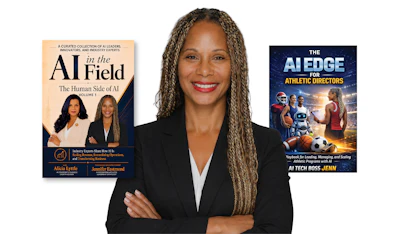
Jennifer Eastmond is the rare individual who identifies as both an athletics administrator and an artificial intelligence expert. A former elite-level club basketball player for the Galloway Lancers in Scarborough, Ont., Eastmond’s journey as an educator, coach and AD has taken her from Lima, Peru, to New York City, where she served six years at the United Nations International School and the past 15 as founding athletics director at Avenues The World School, overseeing 37 teams in 12 sports — from squash to the newly launched softball program. Her chapter contribution to the new book “AI in the Field: The Human Side of AI” is titled “The AI Edge in Athletics: Stop Being the System” and comes on the heels of her solely authored “The AI Edge for Athletic Directors,” published in April. AB senior editor Paul Steinbach asked Eastmond — who calls herself The AI Tech Boss — to explain how she became enamored with this transformative technology.
What does “stop being the system” mean?
Well, as an athletics director, a lot of times we take on a lot of things on our own, and without us, sometimes things might fall apart. Like, we are the system, and everything that we’re doing in terms of — whether or not we’re hiring coaches, whether or not we’re dealing with athletes, whatever it is that we’re doing — everything depends on us, and a lot of that could be a challenge. The premise of this chapter is whatever we’re doing that is on repeat, everything that we’re doing more than once deserves some kind of template, some sort of tool — putting things into a system, as opposed to one-offs, to give us our time back, to give us our energy back, so that way we can be there more with our athletes and our coaches.
When did you first consider yourself an AI expert?
When it started. I know it’s been around for a long time, but it hasn’t been accessible to the public, to the everyday person, until a few years ago. I’ve always been into tech. I’ve always designed websites. I used to code and all that fun stuff. COVID happened, and I was doing a lot of stuff online. I did a lot of challenges for people, and I was just in control of all the tech behind it. Fast forward to 2022, when ChatGPT came out, I was just blown away. Once I got my hands on ChatGPT, I then just started to dive into all the things that AI can do, both creatively with images and videos, and then with automation. I started to automate things in my job, and what I do most now is building. I’ve been building a lot of software programs, and throughout that I’ve been teaching. I’ve had summits, I’ve had webinars, I’ve had programs that people join, and within the different communities I’ve been in, people have always turned to me to help. Because I have that gift of tech, the AI just kind of came very naturally for me, and I just I absolutely love it. I’ve been able to speak and present in different settings and help different people in their profession with AI and how to make their job a little bit easier and make them look better.
What’s the greatest advantage of AI for athletics directors?
As an athletics director, we build a lot of stuff. We build coaches’ manuals and athletics manuals, and now you can put all your thoughts into a tool and come out with a really good manual for your families, for your athletes, for your coaches without having to work on it for months and months and months. What AI does for athletics is it saves you time. It gives you a lot more robust information that analyzes things, and it just really makes the athletics director look better, sound better and feel better because they have more time on their hands.
Is there anything about AI that scares you a little bit?
I’m trying to think. That’s a great question. I mean, it is a disruptor, and it’s going to maybe kind of dislodge people from traditional roles, right?
Do you at least have concerns?
What concerns me most is not that it can produce something that sounds like you, because that’s how you can train it. I think it’s how easily people can just accept it as something that’s polished and accurate, or original or trustworthy, without questioning it. So that’s one thing that concerns me, because AI can sound very, very confident and still be wrong, right? I don’t know if you’ve ever had a conversation with ChatGPT or Claude, but if you challenge it, ChatGPT may be like, “Oh yeah, sorry, you’re right. I was wrong.” Do a little bit of research. Especially if it’s about something in our world, something about safety, something about facilities, staffing or budget — those things that really matter. Just make sure that you research it, even if it’s by using another AI tool.
Do some people expect AI to solve all their problems?
I find this happening to me sometimes, is when people use AI to replace critical thinking instead of strengthening it. People should really use technology and AI like their assistant, not only and solely as their decision-maker. It can certainly help you make a decision. It can help you research faster and organize that information, or maybe even look at patterns. But, really, you as the human should be the final decider with your own experience, your own judgment. You know the context of a situation.
Are there potential pitfalls if AI steals protected ideas?
I guess the last point is really about the ownership. Think about a songwriter. Think about someone who writes scripts for movies. You can copyright it. You can make it yours. We can do a lot with AI and what concerns me is, “Who owns it?” The fact that it can imitate your style or imitate people is great, but also you’re taking someone else’s voice, right? For me, I don’t mind that at all because I’ll copyright things or I’ll trademark items. Copying is always the best flattery, but if someone were to take my work and push it out as their own, that would be more troubling, because it’s a lot more accessible than it used to be.
Because it’s a technology that’s evolving so rapidly, is it hard to write a book about AI? Do you risk having something come off the press and immediately flirt with obsolescence?
I love that question, because when I wrote my first book, I put a lot of actual tools in the book. So, anyone can pick it up and find a bunch of tools and use the tools, and the tools are great, but the tools that were there a year ago, they may not be the best ones today. In that sense, yes, it’s easy to create a book with some of the tools, but I would suggest frameworks and ideas of the type of tool opposed to naming the tool itself, because it changes. I mean, there are some tools that are still around, and they’re still great. Whatever tool works for you. I’m a believer that you don’t need all the new shiny tools anyway. You can choose your top five, and even if you’re using them for five years, and they work — great! You don’t need to have the newest tool, just like you don’t need to have iPhone 17, right?
You’ve expressed that you wish you had AI earlier in your career as an AD. Which tasks would you have applied AI to as an athletics administrator?
Well, when I started as an athletics director, we didn’t have email. I think about what AI has done for me in terms of giving me some time back, and one of the biggest areas is communication. I spend a lot of time as an athletics director in email, responding over and over again. A lot of times, it’s the same response, or I will mull over an email for a while, because it’s charged up or emotional. I love using ChatGPT or Claude to help me with that. I have ChatGPT in my style and tone, so it sounds like me to help me with those tough emails, to help me with those evaluations for coaches. I want to make sure it sounds good, it’s not emotionally charged and it’s getting the point across to them. I would have wanted AI a lot earlier for communications.
What else do you use it for today?
Another area is I do a lot of surveys. Midseason, I do survey. At the end of the season, I do a survey. Over the years I’ve analyzed them myself. I’ve looked at the trends. I’ve gone over it with the coach and tried to figure out, “Okay, was this a good season for their athletes or not?” Now, with one of the software programs I built, it can actually do all that for you. You put it in this system and it gives you a really robust report for the coach to see, “Okay, how did the season go? What are some actions that I can take for improvement?” And it gives the AD some questions to ask the coach. I love AI for being able to integrate the surveys into the coach’s learning and have a really good dialogue, as opposed to just fluff. A lot of times you’re having these conversations, and they’re like, “Oh, I don’t know. I’m going to do X, Y and Z.” Well, this is really based on data. I wouldn’t hand over the judgment to the tool, but it definitely is a good starting point.
How long would it have taken Jenn, the human being, to manually analyze a survey that you had conducted versus your AI software?
When I see something that’s really a big task like analyzing all the survey results, it will take me a minute to even start it because I’m feeling so overwhelmed. That itself is a lot. Then I would say for one survey for one coach or one program, definitely a couple of hours. What I used to do was just comb through it and copy and paste and merge it together. It would take a couple hours. So, imagine if you have 37 teams, a couple hours for each team, that’s 80 hours, more or less, a couple times a season over the full school year. And then the quality may not even be that great.
And when you run it through AI, it’s a matter of minutes?
It’s a matter of minutes.
Are the jobs fundamentally different enough that the AI applications would differ between high school and college?
There definitely are differences, but many of the leadership demands that both face are the same. For example, at the high school level, ADs are often managing smaller staff, smaller budgets, parent education and things like that. At the college level, the operation is just bigger, and now you’re involving more recruiting, more compliance and probably more fundraising than high schools will have. So, even though they’re both dealing with athletes, their specific use of AI may differ, but there is a lot of overlap. They both can use it for communication. They both can use it for scheduling policies. I think I think the biggest difference is the scale and complexity, but both would really benefit from it. At the end of the day, you want AI to create more time for you to be a leader, for you to have those relationships and for you to have better decision-making.
The high school athletics directors who I’ve known always tried to attend as many events as possible. Is it fair to say that the time savings AI might afford them has the potential to free them up to do the fun parts of the job?
Yes, that’s actually what has happened for me. I always tell people that our job is not the computer. Our emails are just one part of the job. The main part of our job is we need to be out there in the field, out there with the parents, out there with the kids and the athletes and the coaches. So, you know, the goal is not for ADs to be faster behind the computer. It’s to get them out from behind the computer. So, when the AI helps them with the emails and the schedules and all that fun stuff, it definitely creates more room for those parts of the job that matter the most — those games, supporting those coaches and being visible. And I found for me, it has enabled me to be out there more. Sometimes it actually it shocks me when I finish something so quickly. I’m like, “Oh, my gosh, I’m done. I can actually go to the game. This is great.”
Are you aware that that today’s athletics directors are taking full advantage of AI, or is there still a lot of room to grow?
A lot of room to grow. I have done a couple of different workshops. I’ve spoken at a conference where I did a survey. There were about 60 people in the room, and I asked them to stand up if they’d used ChatGPT. A lot of them stood up, and then as I was asking more questions, by the time I got to the last question, there were four people standing up.
What was the last question?
It was about if they incorporated that into their everyday lives as an AD, and only four of them were still standing. They were using ChatGPT, typically, for their own personal lives, and some of them used it here and there for their job. But beyond ChatGPT, there wasn’t much more that some of them were doing. One person even came up to me after and said, “You will never get me using AI — ever.” He’s in his 40s. I think they’re afraid. I find that most of them are using it for social media. I find that the ADs who I come in contact with use tools to help them with their content, and that’s only one part of it. A lot of them are unsure where to begin.
What are they afraid of?
They’re afraid of the privacy. They’re afraid of the ethics. They’re afraid of, “Oh, it’s not going to sound like me,” and, “I’m cheating.” You know, the opportunity is much bigger than just “I’m going to write something faster.” It could support them in so much more, like strategic planning, developing your staff, and even analyzing your budget. I had to analyze my budget once, and I was like, “Wow, I’m overspending here.” Even though the numbers are telling me this, it kind of gave me a plan. So, there’s a lot more that ADs can do with it that they don’t even realize.
How do you think AI’s influence on the athletics administration profession will evolve from here? Any idea how pervasive AI is going to be, and any new tasks that you think it will it will help ADs with down the road?
I really think that AI is going to move from being optional to becoming standard as part of athletics administration. Like we mentioned before, many are using it just to write emails or do social media. But in the future, I feel like ADs are really going to see how it can help them analyze trends, anticipate staffing or facility needs, or analyze their budgets. I feel like they’ll be able to say, “You know what? It’s going to help me inform my decisions much faster.” What’s really important, though, is all departments, all schools, will need to have some sort of clear AI policy. I know our school has one. Because a lot of ADs are afraid of AI or they’re not sure how to incorporate it, just starting off with a policy on how we are going to use it to ensure we have privacy and not like it’s unethical.
The human side is still critical.
Definitely. This is a profession that’s safe. I do not see AI replacing athletics directors. Our profession is built on trust. It’s built on relationships. It’s built on us being present, on our judgment. AI is going to just help support us, but it can’t stand on the sidelines. As ADs, we can stand on the sidelines. I think the ADs who really embrace AI will be the ones to impact more athletes and more coaches, just on the strength of them being able to be there more. It will take on that administrative load.
It sounds like it can only benefit their own mental health and longevity in the profession.
Absolutely. Burnout is a thing, and if it can give you your time back, and you’re able to be more visible and be more strategic in your job and be able to leave work a little bit earlier because you got work done quicker. I’m all about sustainable leadership, and that’s what AI has done for me.