Matt Perciak recalls serving as a United States Coast Guard Ensign fresh out of the USCG Academy, conducting boarding missions on suspicious boats off the shores of Hawaii in the early 1990s. He’d disembark from a cutter at Sand Island, Honolulu, after completing a stint at sea, hop in his car and drive the 15 miles to Hickam Air Force Base in Oahu to work out. That’s how subpar the fitness facilities were (and still are in many cases) in Hawaii and at Coast Guard installations across the country.
Today, as the civilian director of the Coast Guard’s Morale, Well-Being and Recreation program, Perciak is actively addressing the fitness shortcomings of the second-smallest branch among America’s six armed services.
And he’s getting help from higher up. On Sept. 2, Coast Guard acting-commandant Kevin Lunday announced that — beginning in 2026 — all Coast Guard personnel will be required to take an annual physical fitness test (PFT), with a physical fitness assessment required before the end of this year. “Readiness starts with the physical and mental readiness of every Coast Guard man and woman,” Lunday and Phil Waldron, master chief petty officer of the Coast Guard, explained in an email to the workforce. “On that cornerstone we build the readiness of the crew, the unit and the force.”
Previously, only those serving in specific capacities, such as boat crew or law enforcement, underwent such testing, according to Perciak, whose active-duty Coast Guard career spanned 23 years until his retirement in 2016. As MWR director since 2018 at Coast Guard Community Services Command in Chesapeake, Va., Perciak is on board with the PFT change, even as his current civilian status exempts him from testing. “It aligns us with the other services, transforming us to be a stronger, more ready and capable fighting force while enhancing our mission readiness,” he says. “It’s pretty exciting.”
The wider application of fitness standards makes Perciak’s job of securing funds for fitness initiatives and infrastructure all the more mission-critical. It’s a charge he refers to as “Fitness Is Readiness.”
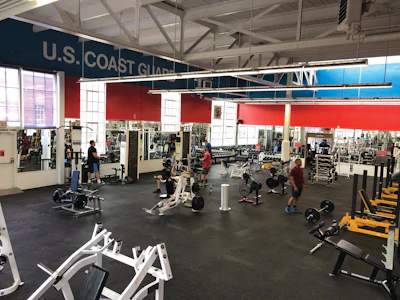
Before
After
Growing the Guard
According to Perciak, the plan is to grow the Coast Guard — now roughly the size of the New York City Police Department — from its current roster of 38,000 active-duty members and 10,000 reservists by another 15,000 by 2028. It’s his hope that such growth brings a substantial increase in MWR’s appropriation, pending Congressional approval.
Says Perciak, “With our big plus-up of 15,000 members, and then a mandate for folks to be mission-ready through physical fitness testing, our contention is we’re going to have to really provide support for the active-duty members through our MWR programming to make sure that happens.”
With more funding, MWR can staff up with fitness specialists and outfit with state-of-the-art equipment the kind of outdated facilities that Perciak avoided 30 years ago. “If you were to go to a Coast Guard fitness center and compare it to a fitness center in one of the other services, you’d see a fairly notable difference,” Perciak says. “The other services generally have staff who are dedicated to sitting in that fitness center and making sure it’s tip top, whereas we basically have a lot of generalists on our staffs. So, what we’re trying to do is bring in fitness specialists to these locations — folks who have the expertise, the background, to deliver the programming that our active-duty members need to be mission-ready. Without that, you have a lot of equipment that just sits there, and people aren’t maintaining it. There’s no one to go to if someone needs help with exercises. We don’t have that, so this is our big push to get us into alignment with the other services and how they operate, to make sure that we have gyms that people want to go to.
“We’re trying to get a little over 70 personnel established within the Coast Guard across 27 units, and then additional operational dollars to support fitness center programming.”
Profits into improvements
Other funding at MWR’s disposal is of the non-appropriated variety. In 2021, the MWR Capital Improvement Fund was established to channel profits from the Coast Guard Exchange — retail stores that sell all manner of goods to qualified shoppers — toward facility renovation projects with price tags of $25,000 or more. “I wanted to do larger-scale things,” says Perciak, “because in the Coast Guard, we don’t have an annual dedicated appropriation line coming from Congress that says ‘MWR recapitalizations.’ ”
Since 2021, the Capital Improvement Fund has infused roughly $15 million into more than 300 projects ranging from the resurfacing of courts to investment in new fitness and playground equipment. “We’ve been able to put a bunch of money into an area that has never really been addressed, and so we’ve made some really meaningful fixes to our programs,” Perciak says. “The interesting thing is, during the same years, we’ve received 825 submissions at a value of $95 million. So, we were able to do 300 of them for $15 million, but there’s still $80 million in projects out there that we weren’t able to do. That’s some of the reason why we’re really making this push through our Fitness Is Readiness resource proposal to get funding to continue doing this stuff.”
It’s all part of a larger government effort examining everything from Coast Guard cutters and aircraft to IT infrastructure, with 2028 as the target date for, as Perciak puts it, “really doing some heavy investment in our shoreside installations and getting everything upgraded to where it needs to be, so we can be an asset serving the nation well into the future.”
With his own service to the Coast Guard spanning three decades, Perciak would like to keep his personal experience in the distant past. “What I want to do is create an environment where our active-duty member gets off the ship in Honolulu and goes, ‘I want to go work out at our gym.’ That’s what we haven’t had,” he says. “So, we’re trying to really plus-up the staff, plus-up the money to bring in the top-notch equipment and get all of our basketball and tennis courts to be what folks want to play on, and just really get us to where we need to be.”
Funding Off-Base FITNESS PURSUITS
In addition to offering indoor and outdoor fitness centers — as well as diamonds, courts and pools — the United States Coast Guard encourages fitness activity off the base by providing access to so-called Coast Guard Sports Grants.
According to MWR director Matt Perciak, Coast Guard Sports Grants reimburse entry fees up to $150 for USCG members who wish to compete in a triathlon, for example, and it has made the request process much easier for would-be participants. In the past, all requests were filed on paper, routed through a chain of command and signed off by a commanding officer before they even reached MWR, and there an application could be buried in a stack 8 inches deep on Perciak’s desk. An online application has expedited the process significantly, resulting in a dramatic increase in requests and Zelle-based reimbursements.
“We’ve seen the grants go from about $4,000 to last year almost $30,000 in grants,” says Perciak, adding the funds come from Coast Guard Exchange profits. “This year, we’re projecting it could be up to $50,000 in grants.”
There’s still a screening process, and applicants looking to see costs covered for their participation in a nontraditional activity or even a team sport are filtered out. “It has to be an individual pursuit,” Perciak says. “It has to be really something that promotes health and physical fitness. If we’re able to provide some offset to them so they can pursue that, it’s a big win for them and for the service.”
USCG Missions
The United States Coast Guard — which unlike the other five branches of the military operates under the Department of Homeland Security during peacetime — is charged with carrying out 11 statutory missions. These include:






 After
After After
After