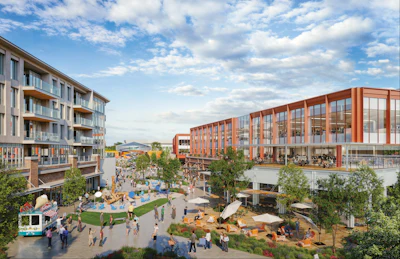
When Jamie Pollard arrived at Iowa State University two decades ago, serving as the point person on a mixed-use development in Ames was nowhere on his radar. “Probably didn’t even know what one was,” admits Pollard, who became ISU’s athletic director in 2005 after serving as deputy athletic director and chief financial officer at the University of Wisconsin.
Back then, no contemporaries at the collegiate level knew much about mixed-use development. Today, multiple campuses are undergoing athletics-adjacent transformations — including retail, residential, entertainment and even medical assets — and few ADs are now as well-versed in the process as Pollard.
It wasn’t until the Big 12 basketball tournament moved to Kansas City’s Sprint Center (now T-Mobile Center) in 2010 that Pollard first began to see potential in bringing tangential attractions to his corner of the college athletics world. By then, the Big 12’s host arena was surrounded by an estimated $8 billion in development known as the Power & Light District, which helped revitalize downtown K.C. beginning in 2008.
Pollard’s entrepreneurial instincts kicked in, and the concept of CyTown was born. “That was really born out of just how well Cyclone fans travel to the Big 12 basketball tournament every March, and this space that they created in and around the basketball arena there is a great environment,” he says. “Tremendous environment.”
Iowa State began assessing what it could do to create that kind of environment on campus, specifically the 94 acres adjacent to and between its own basketball arena, Hilton Coliseum, and Jack Trice Stadium, home of Cyclone football. Commercial real estate agency Cushman & Wakefield had just begun its study of the space when the pandemic put the entire project on pause, but it didn’t take long for the concept to gain more collaborators. Says Pollard, “When we came out of COVID in ’21, we went up and met with the Packers.”
The Green Bay Packers opened Titletown, a parklike destination offering hospitality and year-round activities next to Lambeau Field, in 2017. An ISU alum and member of the university’s foundation board had once been a Packers board member. “That got us in the door,” says Pollard, who had known Mark Murphy, Green Bay’s president and CEO at the time, from their days in the Big Ten Conference (Murphy had served as Northwestern’s athletic director). “They were very key in helping us understand better the financial structure, how they went about it, and what parts they did themselves and what parts they did with a developer.”
Building on history
While stopping short of the multi-use commerce and entertainment destinations of today in such places as The Battery Atlanta, which like Titletown debuted in 2017, Iowa State had a vision for gathering varied interests in close proximity dating all the way back to 1954, when then ISU president James Hilton “envisioned an educational, cultural and athletic complex rising from what was once farmland,” according to CyTown.com. “The vision he cast was realized through development of C.Y. Stephens Auditorium, Fisher Theater, the Scheman Building [a convention center] and the arena named in his honor — Hilton Coliseum.”
That development would become known as the Iowa State Center.
“We already had five buildings in that space, three of which were dedicated to the arts,” Pollard says. “All of those were built 50 years ago, and each one of those buildings is in different forms of deferred maintenance and obsolescence. So, the idea behind this was to create an entity that would ultimately be used to repurpose and revitalize those facilities. We’re essentially adding eight more buildings.”
These include a three-story medical building, a food and beverage building, two five-story residential and retail buildings, two three-story office and retail buildings, a seven-story hotel and conference center, and a 2,800-capacity outdoor amphitheater.
“The Iowa State Center has continued to transform Iowa State and the Ames community for nearly 70 years,” the website continues. “Now, as Iowa State University boldly looks to its future, it believes CyTown will be an initiative that moves the university closer to its strategic goals of fostering lifelong learning, creating and forging new frontiers, and serving as a trusted partner for innovative solutions.”
Heady stuff, for sure, with responsibility placed squarely on the shoulders of ISU athletics.
“We’re on the point,” Pollard says proudly. “It’s a university project, but the [current] president [Wendy Wintersteen] asked the athletics department to take the lead, and for two reasons. Number one, that’s what we do. We’re very entrepreneurial, and quite frankly, most of the campus isn’t. And number two, the area that we’re talking about is directly between the football stadium and the basketball arena. It was going to impact us either way, so we might as well be in charge of it.”
Plans were announced in September 2022, and the infrastructure phase of the project broke ground in February 2023. “That was a $30 million project to raise the area up out of the floodplain about 7 feet, put in all the utilities and redo all the parking lots,” says Pollard, adding that this initial phase was completed in September 2024, with “the area ready to go vertical.”
By then, Pollard’s CyTown team had secured its first anchor tenant, McFarland Clinic, and selected Goldenrod Companies as the project’s developer. Ground was broken on the clinic this spring, and Goldenrod will begin breaking ground on the rest of the development in spring 2026, with completion slated for fall 2027.
“We originally thought — naively — that, ‘Well, we have this land, we’ll just hire a developer and let them go to work,’ and the Packers really counseled us, saying, ‘The more you can do yourself on the front end, the better off you’re going to be,’ ” Pollard says. “The Packers self-developed. They developed and worked directly with their medical piece, with their hotel. They did quite a bit of it themselves. When they started selling the apartments and condos and things, that’s when they went to the developer, and so that was a big piece for us.”
Pollard found that once local red tape had been cleared, CyTown was worthy of national attention. “Because we’re a state entity, it took a good two years to work through the issues with the city, the state and the Board of Regents to get the structure set up — and all the documents and the agreements,” he says. “When we did the bidding for the developer, we originally had been told we might not get a national developer because it’s a smaller market. We ended up with three national developers, one international developer and two local developers.”
The broad interest stemmed from the fact that Iowa State — in a 50-50 financial responsibility split between the university and athletics, and based on recommendations from Cushman & Wakefield — had already paved much of the way. “Number one, we did all the infrastructure work ourselves, so the developer didn’t have to waste time doing all that. We didn’t give it to the developer and say, ‘Now you get the site ready.’ We worked through all the civil engineers and all the other things you have to do to get the site ready,” says Pollard, adding that process alone took two years. “And then the second piece of advice was to get all the agreements done with the city. Don’t make the developer have to do that.”
By taking these extra initial and internal steps, Iowa State positioned itself as a plum job in an increasingly crowded marketplace of collegiate multi-use district development. “Our developer didn’t bid on Kansas or Tennessee, in large part because they didn’t do those two things,” Pollard says. “They were asking the developer to do all that, and from the developer’s standpoint, that’s wasted time. Most developers are trying to get a return on their assets, and that’s extra time and money they have to spend before they’ll ever get a return.”
Real estate agents
Iowa State athletics was also heavily involved in determining the what-goes-where aspects of CyTown, with the athletic director, the athletic department CFO, the president of the Iowa State Research Park, the university’s general counsel and its vice president for finance comprising a management committee that met every Wednesday at 9 a.m. for four years. Says Pollard, “That’s how you stay on top of all that, as we worked through the iterations of the project layout.”
When asked to explain the involvement of the Research Park, Pollard says, “The Research Park is a big part of the physical structure, meaning that a state-owned project wouldn’t be able to be very entrepreneurial because of bidding and just the fact that things take a lot longer. The Research Park actually was set up years ago to be an entity that the university could donate land to and then let the Research Park board go do what they do, which is enter into agreements with all the different entities — John Deere, Case — that the research park brings in to allow them to build buildings on our land for entrepreneurial reasons.”
The acreage between Hilton Coliseum and Jack Trice Stadium had seen ownership transferred from the university to the Research Park to expedite CyTown’s development.
Pollard admits he can’t definitively claim to be the first to pursue a mixed-use development at the college level, but he’s confident Iowa State started before the likes of Kansas, Tennessee and Wake Forest. Moreover, he concedes that other campuses are simply hamstrung when it comes to this kind of expansion.
“Most places don’t have the access to real estate,” says Pollard, using his old Madison, Wis., stomping grounds as a prime example. “You’re not going to do anything around Camp Randall [Stadium]. There’s no parking. Here at Iowa State, we’re very much like Lambeau Field, where you just had lots of flat space.”
Parking near Hilton Coliseum and Jack Trice Stadium was not only in shambles, as Pollard describes it, but lots were occupying prime real estate on the proposed CyTown site. The athletic director again found inspiration while in Wisconsin, attending a game involving one of the state’s other major professional sports franchises — the Milwaukee Brewers.
“When you walk east out of American Family Field, over the highway back to the other parking lots, you don’t even realize you’re above the ground,” he says. “We decided we could build a bridge from the stadium over the floodway, and we said, ‘Why don’t we put parking over here?’ So, we built a huge RV park. We got two donors to give us $5 million each, and we built a bridge. It’s now maybe the most iconic structure at Iowa State, because it’s all lit up as soon as you enter campus. That bridge allowed us to create a 300-space RV park, which then freed up a bunch of parking that we had been using on gamedays. That was all part of the vision for CyTown.”
Every aspect of CyTown is intended to bring more people to this location — essentially equidistant between the ISU campus and downtown Ames — and for more of the calendar year.
“Right now, we get about 1.3 million visitors throughout the year based on the athletic activities, the performing arts, the daily commuters that all park in that 94-acre space,” Pollard says. “What we needed to do was create additional traffic. That’s part of the idea behind the medical clinic. It’s 150 doctors and staff and 850 appointments a day. They’re going to bring 1,000 people to that space who currently don’t come there on a daily basis. The amphitheater, obviously, will bring more. The hotel and convention center will bring more. We have things like a big, oversized children’s playground area. And then we’re doing a replica football field, kind of like the Cowboys did at The Star.”
Floodplain to revenue streams
So how, exactly, does Iowa State athletics and the university at large stand to gain from this?
First, CyTown is branded, trademarked and marketed as a partnership vehicle independent of existing athletics rights agreements — another lesson learned from the Packers.
“We want everything to feel like Iowa State University,” Pollard says of the CyTown vibe. “It’s very themed. It’s the same colors. It just creates another vehicle to drive revenue, and so our multimedia rights deal didn’t just include this — like, ‘Now they get that inventory.’ That’s all new inventory with different naming rights opportunities. It was all set up that way to be able to create a financial model that allowed us to have new revenue streams.”
Another key aspect of the financial picture is how the physical pieces of CyTown are ultimately owned and operated.
Pollard explains: “The revenue streams for us, and I mean CyTown when I’m saying this, is number one, the land lease and the land lease improvements — so payment for use of the land. There’s also payment in lieu of taxes, or PILOT. Because we’re state, technically we don’t owe property tax on the land or the vertical, but we are going to collect it and keep it ourselves for the project. And then the third revenue stream is from the developer — the operating revenue that each of these buildings generate.”
Each building will generate its own profit and loss, with CyTown claiming a share of that based on the equity ISU and the athletic department have in any one of the buildings. “For example, in every building, we’ll have the land and land improvements as our equity, but some buildings will have more,” says Pollard, noting that a donation paid for part of the amphitheater and donations have flowed in to hold residential spots. “So, whatever our equity is, that’s what we share in the P&L with the developer. There might be some buildings where we’re 50/50. There might be buildings where we’re 20/80 in P&L.”
Iowa State was careful to protect its short- and long-term interests. “You also want to maintain control,” Pollard advises, “because, in our case, it’s on a university campus. Like we’ve said from the get-go, so many different development projects get TIF [tax increment financing] from the city, they build it, and it’s all empty retail. There’s just glass. There’s nothing in there because they couldn’t lease it up. They were able to get the TIF to build it, but then they go and flip it and move on to their next project. The worst thing we could have is empty buildings in the middle of this project.”
To avoid that scenario, CyTown partnered with Goldenrod not solely as its developer, but to operate the buildings, as well. CyTown will lease the buildings to Goldenrod for 30 years, with four additional five-year options, and Goldenrod will sublease space to tenants. As of this summer, 300 entities had already expressed interest. Says Pollard, “They’re going to make money by operating, so they’re being very particular about who the tenants are, because they want tenants that are going to be successful.”
ISU, meanwhile, maintains ownership of each new structure. “That was really important to us. We’re going to own all the buildings,” Pollard says, adding of Goldenrod, “They’re building them all. They’re taking all the risks. They’re putting $250 million into the project. But as soon as they build a building, the university owns it, and Goldenrod gets to use it rent-free for the duration of the lease. At the end of the lease, we still own the building.
“Part of the reason we did it that way is, one, that allowed it to be tax-free, so that we could keep the taxes. If we let the developer own it, then the developer has to pay taxes to the city. And number two, it prevents the developer from just going and selling off our land and buildings and making money off of us. So that’s been my advice — proceed cautiously and don’t just turn it over to somebody to make money off of your land.”
Pollard told AB in early September that Iowa State athletics was close to signing a 10-year extension with Learfield, with a significant increase in potential revenues resulting from the nation’s leading sports marketing firm now being able to sell sponsorships into CyTown. “CyTown is going to be a big asset for the university and athletics in helping address future challenges associated with funding” in the post-House v. NCAA era of revenue sharing, the athletic director says.
Not all schools can do what Iowa State and others are in the process of doing, but if they possess the real estate and an entrepreneurial spirit, mixed-use districts hold the promise to make a difference in these unprecedented financial times. Having both land and leadership vision has clearly helped Iowa State get the jump on other schools in this space. “It goes back to my kind of saying it in passing, but there’s truth, colleges just aren’t very entrepreneurial,” Pollard says. “They’re set up to get money and then spend it. They’re not really set up to make money.”
More athletics departments are sure to challenge that mindset moving forward. “Number-one advice, do as much of it as you can yourself,” says Pollard, echoing the playbook he received from the Green Bay Packers. “The more you can make it turnkey for the developer, the better off you’re going to be.”
CYTown By the Numbers
8 new buildings
60 one-of-a-kind living units
215 hotel rooms
72,000 square feet of retail/food and beverage space
96,000 square feet of office space
2,800-capacity outdoor music venue
$200 million cost
Growing trend
Here’s how the athletics-adjacent multi-use districts currently in development at three Division I universities stack up.
CYTown, Iowa State University $200 million — outdoor amphitheater, retail space, restaurants, residential units, 215-room hotel, office space
Neyland Entertainment District, University of Tennessee $288 million — retail space, restaurants, residential units, 240-room hotel with rooftop restaurant and pool, conference center, 60 luxury condos
Gateway Project, University of Kansas $808.7 million — Booth Memorial Stadium renovation, new conference center, outdoor plaza, hotel, student housing, retail space
Revving Up RV Culture
Iowa State football gamedays have always made room for fans who descend upon Ames in recreational vehicles. In CyTown, ISU is rolling out the (cardinal) red carpet for RV drivers.
Opened in September 2022 as one of the first tangible signs of progress in ISU’s mixed-use development, the new RV lot accommodates 300-plus big-rig visitors with next-level amenities.
“Before, we had 200 RVs that parked in a parking lot with no electric hookup, no nothing,” says Iowa State athletic director Jamie Pollard. “Now everyone has a cement slab, a grass area and electrical hookup. It’s quiet, because no one’s running their generators. And their spot’s reserved, so they know they don’t have to get in line to get the spot they want. That spot is theirs, and they donate to get the spot. We went from 200 to almost 350 RVs out there now.”
With that kind of ownership has come a sense of community. “It’s kind of now created its own culture,” Pollard says of the enhanced lot and its occupants. “They have their own Facebook page. We do music out there for them. During Halloween, there’s trick-or-treating. It’s pretty cool.”
ISU officials have contemplated ways to turn gamedays into weekends — and idle weekends and offseason months into enhanced traffic opportunities — by engaging one of CyTown’s other features: a 2,800-capacity amphitheater. “We’ve talked about a Friday night concert series before the games, because the RV people could walk over the bridge and go to the shows on Friday night,” Pollard says. “We’ve talked about watch parties for road games, concerts throughout the summer. The sky’s the limit.”