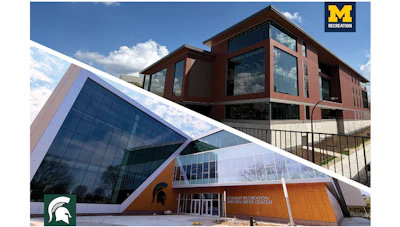
Within the span of a few months, the two largest public universities in Michigan will have opened new campus recreation facilities this year. Both the University of Michigan and Michigan State University compete for students as tirelessly as their sports teams compete against each other in the Big Ten Conference. But as those institutions embark on new campus rec eras, recreation professionals on both campuses agree on at least one thing: Involving students in every facet of the planning and design process is critical to planning and developing the next generation of facilities.
“The student voice is as impactful as it’s ever been,” says Mike Widen, director of Michigan Recreation at the University of Michigan, where administration pivoted from a proposed $45 million renovation of the 50-year-old Central Campus Recreation Building to construction of the new $178 million, 219,000-square-foot Hadley Family Recreation & Well-Being Center set to open this summer. “Students are really pushing for institutional support for their wellbeing. Ann Arbor is a great place to go to college, but the recreation facilities historically didn’t match the U-M brand. The students saying, ‘Our wellbeing needs to be improved by creating spaces that actually draw us in,’ has been pretty consistent from class to class.”
“Students absolutely played a huge part in the new facility,” adds Marcus Jackson, director of Recreational Sports & Fitness Services at Michigan State, which opened its $200 million, 293,000-square-foot Student Recreation and Wellness Center this spring, replacing the 67-year-old IM West facility. “We owe a lot to the Associated Students of Michigan State University [MSU’s undergraduate student government], which proposed a new student-supported recreation fee. Students had been clamoring for this for a while.”
At both Michigan and Michigan State, student body representatives served on campus committees with university administrators, architects and other planners; helped select equipment; and sometimes even traveled to tour other recreation facilities on campuses around the Midwest.
“We compare ourselves to each other a lot,” Widen says about the Michigan/Michigan State rivalry. “And I think what’s happening right now in recreation on both campuses is pretty special for the state.”
Two campuses, similar challenges
The nation’s first facility built specifically for campus recreation, back in 1913, is located on the Michigan campus — and it still stands today. Known as the Intramural Sports Building, it was renovated in 2016, followed by renovation of the North Campus Recreation Building in 2018. But Widen admits to some “ebbs and flows” over the decades as the university tried to live up to its rich campus recreation legacy.
“Our industry saw a boom in collegiate recreation facility projects in the ’90s and into the 2000s, when it seemed like a lot of institutions were building new campus recreation centers, and we were kind of late to the party on that,” he says. “Now, we have one of the newest facilities in the country.”
When it opens, that facility will feature four gymnasium courts; multiple strength, cardio and functional training spaces; a climbing center that includes top-rope, bouldering and speed climbing; an aquatics center with three separate pools (lap, recreation and recovery); a sauna and steam room; a running track; racquetball and squash courts; a turf court and turf ramp; six group exercise/multipurpose rooms; mind-body and cycling studios; personal training suites; wellness/social lounge areas; men’s, women’s and inclusive locker rooms; an athletic training room; and an outdoor patio. The center also will be one of the first facilities on the University of Michigan campus to be certified LEED Platinum.
Students had pushed for upgrades to all three existing recreation centers on campus since at least 2013, according to Widen.
“There was a lack of love for recreation facilities at the time,” he says. “But the need to have our aging facilities match the Michigan brand was really important to students. So, those students led the charge, generating a lot of advocacy across campus. One of the students on our advisory committee and I gave a tour of the old Central Campus building to the provost and president — who said, ‘We need to do something.’ That’s when the conversation really started.”
Jackson recounts a similar story regarding the origins of Michigan State’s new Student Recreation and Wellness Center, which had a soft opening in April and will celebrate an official grand opening this fall. The three comprehensive recreation facilities on that campus were built between 1918 and 1989. IM West, which the new center replaced, opened in 1959, and (as at Michigan) the other two facilities previously underwent renovations.
“We had campus leadership with differing perspectives on the need for enhanced recreation amenities, and then we got leadership that did feel that need, and that’s when this movement started,” says Jackson, who previously had been involved with new campus recreation facility projects at two other universities. “But without the level of student engagement we had, I do not believe the new facility would have happened.”
Highlights of the new facility include a three-story climbing wall; 30,000 square feet of fitness spaces in rooms of varying sizes and designated by skill levels; multi-use activity courts and an indoor turf field; a weight room; a 50-meter swimming pool with moveable bulkheads; two matted multipurpose rooms; a table tennis alley; inclusive restrooms and locker rooms; sports simulators; a personal training suite; and designated wellness spaces, including Hammock Grove — located beneath select stairwells to encourage students to bring their own hammock and relax among synthetic trees.
With such compelling stories to tell — and sparkling new facilities to show off — Michigan and Michigan State will team up to co-host the Big Ten Collegiate Recreation Conference in 2027. The campuses are located about an hour’s drive from each other, and both new rec centers are expected to serve as event centerpieces.
‘Not just square footage’
The fact that students rallied to play such a large role in the development of new facilities at Michigan and Michigan State is proof that campus recreation centers have, indeed, become the most vital hub of college life. And that’s a lesson applicable to anybody designing and building a new rec facility in 2026 and beyond — at either the university or municipality level.
“We can no longer afford to build facilities that are just fitness centers,” Jackson says. “We have to expand our thinking on what recreation and wellness is about and make sure that fits the desires of the student body and university as a whole. We’re still dealing with huge challenges around mental health and wellness, so let’s think about the student experience — not just square footage. We don’t just need larger spaces. We need to think about what our students need. What are they asking for, and what are they missing? The best way to do that, obviously, is to engage them early and often.”
The payoff, according to Widen, is worth it.
“We know we’ve been successful when alums come back and say, ‘I wish this would have been here when I was in college.’ We’ve had those conversations before, and I expect them to continue once we open the Hadley Center,” he says. “I think we are creating something special that students today can be really proud of.”