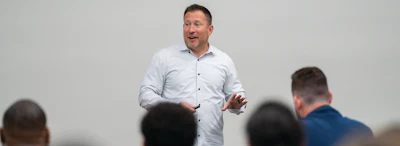
When we opened our health club years ago, I never imagined I would one day stand on conference stages, co-author a book or write this regular column in Athletic Business. I was just trying to run a great club and create a great experience for our members.
Then something unexpected happened that changed everything.
Our club participated in an industry study measuring Net Promoter Score, and we achieved the highest NPS in all of North America. An industry trade journal reached out to interview me about how we pulled it off. As I answered questions about our member experience strategies and team culture, I had a lightbulb moment: “Maybe I could present this at a conference.” So, I did something terrifying. I applied to speak at an industry event. To my surprise, I was selected.
That first presentation led to another, then another. Eventually, I was invited to write articles, which led to this column and later to co-authoring (with Steven Trotter) my first book, Fitness Facility Management.
Have you ever felt like you have something valuable to share, but don’t know where to start? Let me show you the path I took. You’ve already done the hard part by gaining real experience and solving real problems. Now it’s just about finding the right platforms and building the confidence to share what you know.
Identify your unique expertise
Here’s the truth: you don’t need to be an expert on everything, you just need to be knowledgeable about something. What problems have you solved in your facility that others consistently struggle with? What do colleagues or members ask you about repeatedly? What systems have you built that work?
Stop right now and make a list. Write down your top three to five areas of expertise. These don’t have to be earth-shattering. They just need to be real. Your expertise doesn’t have to be revolutionary. My presentation on member experience wasn’t academic theory. It was boots-on-the-ground experience from running an actual club. That’s what made it valuable.
I know what I know. Customer experience, leadership, employee engagement? I’m your guy. Technology, AI, complex data analytics? Not so much. And that’s perfectly fine. Stay in your lane and own it.
Think about the informational void you’ve experienced in your own career. What did you wish someone had taught you earlier? What lessons did you learn the hard way? Those pain points you’ve navigated are exactly what others need to hear about. Your unique perspective, shaped by your specific experiences, is something no one else can offer.
Start small, build confidence
Now that you’ve identified your areas of expertise, here’s a mistake I see many people make: they fall into one of two traps. Some think they need to land a keynote or get published in a major trade magazine right out of the gate. Go big or go home. Others don’t feel confident enough to go big, so they don’t go at all. Both mindsets will keep you stuck.
Here’s another truth: you’ll never feel 100% ready. I wasn’t ready to present at my first conference or write a book, but I said yes anyway.
Start small and build from there. Even though I jumped into a solo conference session, I practiced that presentation for friends and family first. I offered to do it for other businesses and local organizations. Each time, I refined my delivery and learned what worked.
If you want to speak, start by volunteering to lead a session at your next staff meeting, present to a colleague’s organization, or offer a free lunch-and-learn. Better yet, co-present with someone more experienced or join a panel discussion. These formats take pressure off since you’re not carrying the entire session alone.
On the writing side, I started writing a newsletter and contributing blog posts to websites long before this column or my book. Offer to write for a quarterly industry newsletter, your facility’s communication or a website blog. Write a detailed LinkedIn post about a challenge you recently solved.
Each smaller opportunity serves two critical purposes. First, you refine your message. You’ll quickly learn what resonates and what falls flat. Second, you build confidence. Do it in lower-stakes environments first, and by the time you’re ready for a bigger stage, you’ll have found your rhythm.
Document your creative process
Now that you’ve committed to taking action, you need to choose your platform and organize your content. I love it all: speaking, writing, podcasts. Maybe you prefer one over the others. Pick what aligns with your strengths and interests.
I believe anyone is capable of anything. Everything is a skill that can be developed, but start with what you genuinely enjoy. I began with speaking because I loved the energy of live audiences. That led to writing opportunities, which I discovered I also loved. Eventually, I combined both into consulting work. Your path will be unique to you.
Once you’ve chosen your platform, start assembling your content. As you solve problems and learn lessons in your facility, write them down. When I have an idea, I immediately jot it in my notes. When I attend conferences and see interesting session topics, I write them down to prompt future ideas. When I chat with industry colleagues and issues arise, I capture them. Don’t be afraid to ask other professionals what topics they’d like to learn more about or what challenges they’re facing. Their feedback can spark ideas you hadn’t considered. These aren’t polished yet. They’re just seeds to be cultivated later.
If you’re planning to speak, here’s a process that works. Start by selecting your best topic, then craft a compelling title, write a clear description of what you’ll cover, and outline your learning objectives. This helps you structure the content so you can actually deliver it. It also happens to be exactly what most conference applications ask for.
For writing, keep a notebook or digital file to collect ideas, save emails from satisfied members, track your results and metrics, and take photos of before and after transformations. Build what I call a “content library.” Real examples trump theory every single time.
When I applied for that first speaking opportunity, I could point to our NPS score, share specific strategies, and show tangible outcomes. That’s what got me selected. Your lived experience, documented and organized, is your greatest asset.
Overcome imposter syndrome
Everyone feels unqualified at first. Before that initial presentation, I questioned whether anyone would want to hear what I had to say. What if my strategies only worked for my situation? What if people thought my ideas were obvious? But here’s what I learned. Your experience is valuable precisely because you’ve lived it. You’ve tested these ideas in the real world. You’ve made mistakes, adjusted and found what works. That practical wisdom is exactly what the industry needs.
Imperfect action beats perfect planning every time. You don’t need to have everything figured out before you start. Submit a proposal to one conference. Write one article. Share one thoughtful LinkedIn post. Most conferences post open calls for speakers on their websites months in advance, and the application is usually straightforward, asking for a session description and your bio. The hard part isn’t the form. It’s clicking submit.
Yes, you might face rejection. I certainly have. I’m not booked every time I apply to an event. But eventually you’ll experience the incredible satisfaction of helping someone solve a problem they’ve been struggling with, all because you were willing to share what you learned.
Your turn to step up
My journey started with one trade journal interview and one conference application. I didn’t have a master plan. I just realized I had something worth sharing and took a chance. Our industry grows stronger when we share what we know. We need diverse voices, different perspectives and real-world experiences from operators like you who are in the trenches every day, solving problems and serving members.
What you already have — your unique experience, your hard-won lessons, your innovative solutions to common challenges — is worth sharing. The question isn’t whether you have anything valuable to offer. The question is, when will you start offering it? The industry is waiting for what you have to teach us.
What’s one step you’ll take this month to begin? Submissions for AB Show 2026 are open now. Maybe that’s your first step. I hope to see you on a conference stage soon, read your article in a trade publication or hear about the workshop you led. Our industry needs your voice.