City of Coronado (Calif.) Recreation Services professionals manage the unique challenge of staffing both a traditional pool environment and a busy bayside recreation area, as AB Show 2025 attendees learned last November.
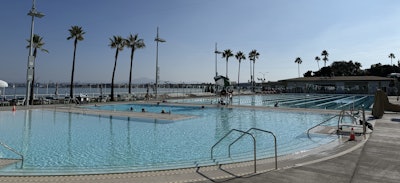
The aquatics center features a configurable 50-meter lap pool with a functional bulkhead that allows the facility to accommodate 50-meter courses, 25-yard and 25-meter swims, as well as diving activities — all requiring skilled lifeguard coverage. Beyond the pool, the department operates Glorietta Bay, an open-water recreation area where residents and visitors paddle, take classes and rent vessels year-round.
Karina Craig, aquatics supervisor for Coronado Recreation Services, says the department’s approach to safety and security across these dual environments depends on thoughtful planning and staff development to create a system that keeps patrons safe whether they’re in the pool or paddling out on the bay.
The foundation of Coronado’s approach is straightforward in that every lifeguard is trained and certified to work competently in both settings. “All of our lifeguards are trained to work both sides,” Craig says. “Every single one of our lifeguards is American Red Cross lifeguard certified, which includes CPR, AED and Title 22, which is like an advanced first aid for the state of California. In addition to that, they also have waterfront certification.”
The department implements yearly recertification, even though American Red Cross credentials remain valid for two years. While the pool operates under standard rotational practices, Glorietta Bay presents a more complex arrangement that reflects the reality of operating in a public, open-water setting with year-round patron access. The beachfront is patrolled under what Craig describes as “layered protection,” coordinating with the City of Coronado’s beach lifeguards, who report to the local fire department. The beach guards staff an official lifeguard tower during peak summer months, but the bay sees use year-round, and Coronado’s recreation department lifeguards must be capable of responding to emergencies even when beach personnel aren’t officially on duty.
Beach guards handle general rescues in Glorietta Bay, while Coronado’s staff focuses on patrons using boathouse services, which include kayak and paddleboard rentals, as well as paddling classes, camps and tours. The whole system is designed for seamless coordination when emergencies occur.
“Let’s say there was an emergency that happened in Glorietta Bay,” Craig says. “My staff are also trained to respond. We call the lifeguard tower, which is located on the beach side of things just to let them know that we’re making a rescue.”
This communication protocol allows beach guards, who monitor cameras covering the bay, to provide additional visual support and dispatch backup as needed.
Flexible staffing environments
The cross-training imperative at Coronado is an operational necessity that drives daily flexibility. All staff complete orientation checklists for both the boathouse and pool facilities.
“We can flip flop and pull people as we see fit, because all the staff are trained to work both environments,” says Craig. The department leverages this flexibility throughout the day and across seasons. On slow days at the boathouse due to adverse weather, staff can shift to support the pool. When the boathouse experiences high demand with multiple rentals and classes, pool lifeguards can be reassigned.
“We have to always take into consideration things like weather and wind, as well as water quality. But sometimes the boathouse will be shut down and we can pull those staff to come help on the pool side.”
Coronado’s training philosophy reflects pragmatism rather than rigid schedules. The department conducts monthly in-service training throughout the year, rotating between pool and waterfront skills. Training is designed responsively based on actual observed needs. “We base our monthly in-service training on things that we see are the most important for that time of year,” Craig says. “We literally create our monthly training schedule on what the need is.”
Remarkably, Coronado hasn’t experienced the lifeguard shortage plaguing much of the country. “I’m very well staffed in the summertime, when I could have upwards of 90 lifeguards on staff working between both sides,” says Craig. “And then in the offseason, I have about 50 staff members working.”
Craig attributes this success to Coronado’s desirable coastal location and the quality of the department’s operational culture. “It never fails,” she says. “We have so many people who want to work here and applications coming in nonstop.”
Collaborative partnership
Craig emphasizes the critical importance of external partnerships. Her advice to other rec departments is to cultivate close relationships with local fire departments, EMS personnel and other relevant agencies. At Coronado, this collaboration is formalized and ongoing. The fire department participates in annual in-service training, providing instruction on critical response procedures.
“I think the collaboration between departments is super important, having those close relationships with other entities like the fire department and EMS,” says Craig. “We do certain trainings to incorporate the other departments and divisions, so that you can do things like a mock rescue and run it all the way through 911 and having the fire department respond.”
Beach guard staff similarly participate in Coronado’s in-service training, strengthening relationships and ensuring clear communication protocols. “The fire department will come and do a portion of our summer in-service training for all the staff,” Craig notes, adding that the collaborative approach transforms what could be fragmented safety responses into a coordinated system in which everyone understands their role.
For recreation departments managing multiple aquatics environments, Coronado’s model offers valuable insights. Universal certification, meaningful cross-training, adaptive and continuous training, collaborative partnerships, and adequate staffing combine to create both safety and operational flexibility. Coronado’s experience proves that while managing dual environments can be challenging, thoughtful planning and genuine commitment to staff development transform that complexity into an operational advantage — one that ultimately serves patron safety more effectively.