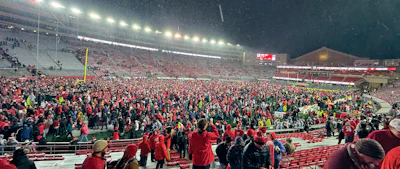
Rushing the playing surface at the collegiate level has become a contentious issue among administrators, owners, spectators and stakeholders. These celebrations typically occur after a major upset or a historic victory, or following events featuring rivalries or top-ranked matchups.
At its core, rushing to the playing field is a communal experience. The act is not just about the celebration; it represents a powerful sense of belonging, unity and shared identity with a team and its accomplishment. Spectators relish these moments and engage in this shared experience by rejoicing with the team, hugging and high-fiving strangers, and documenting it on social media. It’s a phenomenon that is deeply ingrained in school spirit and tradition, fueled by the game’s emotional intensity. As college sports continue to grow in popularity and visibility, these moments are increasingly amplified and scrutinized.
Parsing the data
A group of research affiliates from the National Center for Spectator Sports Safety and Security (NCS4) has created a comprehensive, ongoing collection of field incursion data documenting variables such as patterns, frequencies, causes, institutional responses, team rankings, known rivalries, potential trigger events and injuries. Data collected from internet search engines and shared sources have documented more than 90 collegiate field or court incursions since 2022. Many of these incursions occurred when football and basketball teams were nationally ranked, or the opposing team was considered a rival. Some institutions experienced multiple incursions, suggesting that current deterrents are not consistently effective.
While these celebrations may enhance school pride, marketing opportunities and long-standing traditions, they also introduce significant safety, security, liability and financial risks. In 2024, two high-profile cases drew national attention when collegiate basketball stars Caitlin Clark and Kyle Filipowski were both knocked over during separate court-storming incidents, raising concerns about athlete safety and potential consequences for future earnings.
Even more alarming are cases involving severe injuries to fans. In 2023, a University of Toledo senior suffered a broken neck during a field rush, and in a separate incident, a Ball State student was permanently paralyzed following a goalpost collapse. These incidents highlight the potential for life-altering consequences. Victims may face long-term physical disabilities, mounting medical expenses and psychological effects, such as post-traumatic stress, anxiety and depression.
Broader risks
Beyond individual injuries, the broader risks associated with crowd surges are substantial. When large groups of people move simultaneously into confined spaces, the potential for crowd crushes, stampedes and structural failures increases drastically. Historical examples underscore the severity of these dangers. The 1989 Hillsborough Disaster, which resulted in 97 deaths, remains one of the most tragic reminders of the consequences of inadequate crowd control. Similarly, a 1993 post-game rush at the University of Wisconsin’s Camp Randall Stadium led to 69 injuries, including multiple spectators requiring CPR. More recent incidents, such as a railing collapse at FedEx Field and a partial stadium collapse during a soccer match in Algeria, demonstrate that structural vulnerabilities can turn celebrations into disasters.
In response to these risks, universities and athletics conferences have implemented a range of crowd-management strategies. Common approaches include creating secure exit pathways for visiting teams, delaying post-game access to the field, designating specific celebration zones and increasing the presence of security personnel. Some institutions impose disciplinary measures, such as fan ejections, bans or arrests. Financial penalties have also become a widely used deterrent; however, there are no standardized fines across conferences. In a review of eight collegiate conferences, fines were assessed at flat rates or scaffolding fees ranging from $25,000 to $500,000. For instance, Florida State University was fined $50,000 by the ACC in 2025 for a field rush that caused 19 injuries, while Mississippi State University received a $500,000 fine from the SEC for a similar incident during which no one was hurt.
Despite these measures, enforcement remains inconsistent. The NCAA currently allows individual institutions and conferences to set their own policies regarding fan behavior, resulting in a “wild west” approach with varying levels of transparency and accountability. The effectiveness of fines and other deterrents is debated, as repeat incidents suggest that financial penalties alone may not be sufficient to change behavior. Some officials have even proposed more extreme solutions, such as forfeiting a win if spectators rush the field, though such measures have yet to gain widespread support.
Tradition versus safety
Complicating the issue further is the cultural and emotional value placed on these incursions. Many spectators, coaches and public figures continue to romanticize field-storming as an essential part of the college sports experience. After Vanderbilt’s upset victory over Alabama in 2024, head coach Clark Lea acknowledged that fans should not be on the field but nostalgically celebrated the moment as unforgettable. Similarly, Mississippi governor Tate Reeves publicly endorsed the value of such celebrations on X after Mississippi State was penalized for the 2025 field incursion, stating, “Worth. Every. Penny.” Both cases suggest that the perceived emotional payoffs of these incursions outweigh the financial penalty.
The tension between tradition and safety presents a significant challenge for policymakers and institutions. On one hand, rushing the playing surface embodies the passion and spontaneity that make college sports unique. However, it also poses serious safety, legal and financial risks. Incidents in recent years have demonstrated the potential for both minor and severe harm, highlighting gaps in current crowd-management strategies. Despite efforts that include fines and increased security, inconsistent enforcement and ongoing cultural support for these events limit the effectiveness of deterrents. Moving forward, institutions must balance preserving the spirit of celebration with the implementation of more standardized, effective measures to ensure the safety of all live event participants.