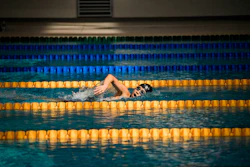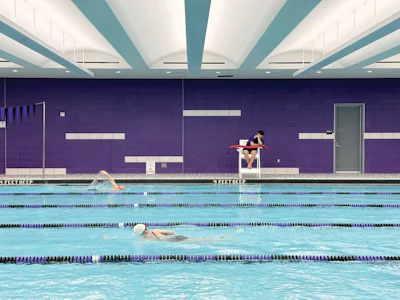
The tǝmǝsew’txw Aquatic and Community Centre is the rare all-electric aquatics center that boasts Canada’s Green Building Council’s Zero Carbon Building design standard. Located in New Westminster, B.C., just outside Vancouver, tǝmǝsew’txw (pronounced tǝ-mu-see-out) had several obstacles to overcome in its path to becoming a shining example of sustainable pool design.
Tǝmǝsew’txw opened to the public in May 2024, but work to bring this aquatics center to life was years in the making. The completed facility includes four pools, saunas, steam rooms, a fitness center, a gymnasium and community rooms.
“There was about two or three years of prework that we partnered with the city on to set the project up for success,” says Paul Fast, principal at hcma architecture + design. New Westminster conducted several surveys to create a vision for the project that would most benefit the community.
When asked what prompted the focus on sustainability for tǝmǝsew’txw, Fast cites New Westminster’s declaration of a climate emergency. “The impetus to look at very ambitious sustainability objectives for the project came from the New Westminster City Council,” Fast says. “They adopted a strategic plan called ‘The Seven Bold Steps.’ It really laid out a framework for the city to pursue some aggressive, advanced strategies in green building.”
The community pressure for a multiuse facility that would replace the legacy Canada Games Pool, designed in the 1960s as a competitive swimming venue, incentivized the city and builders to make tǝmǝsew’txw a multifaceted building that was highly versatile and adaptable, meeting the user experience expectations of a much broader demographic while also being eco-friendly.
Says Fast, “The types of pool tanks we’re talking about, the types of features we’re talking about, where people spend time in a natatorium, that is all changing because of this shift and increased focus on health and wellness.”

Air and water
For facility owners seeking sustainable solutions for their aquatics facilities, many may find themselves asking the question: What is more important, sustainable materials and products or sustainably designed utility systems?
For Carl Nylander, engineer at Counsilman-Hunsaker, the answer is “weighted more toward the utility side.”
Sustainable mechanical systems that keep the water clean and the air fresh are key when it comes to designing an eco-friendly aquatics center. These mechanical systems are typically the highest energy consumers in a facility, but at pools such as the John A. Paulson Center at New York University, an on-site chlorine generation system, regenerative media filter and ultraviolet light systems were key components in the achievement of LEED Gold certification.
“Those systems come with pretty high efficiencies, require less power and reduce greenhouse gas emissions,” says Nylander.
Of course, there are eco-friendly products at the NYU pool, as well, such as the lifeguard chairs made of fully recycled materials and the tiled pool interior. But when looking at the big picture of sustainable pool design, all the pieces — products and utilities — must come together. At times, those sustainable design decisions can reach beyond the pool deck. As Nylander says, “The waste heat from heating the pool is also used to produce chilled water for cooling needs within the building, like air conditioning.”
With these renewable processes in place, a pool meant for recreation and fitness is also serving as part of the building-wide commitment to sustainability.
The utilities are of equal importance at tǝmǝsew’txw, which also relies on a regenerative media filter. Says Fast, “You have two challenges with an aquatics center on the energy side. One is water cleanliness and heating. The other is air quality.”
The use of mass timber improved air quality at tǝmǝsew’txw, which Fast describes as a “carbon sink” particularly suited to aquatics centers.
“The air in a pool has a high degree of chlorine, or trichloramine, in it. Those trichloramines can corrode steel at an enormously fast rate, so if you use steel, then you’re always worried about how to protect that steel. It’s very expensive and there are a lot of quality control issues,” Fast says. “You can put a piece of wood into a facility like that and it will take in those trichloramines and give them back out without any corrosion issues.”
At the John A. Paulson Center, mass timber wasn’t possible for the Manhattan skyscraper, which features fritted glass and a green roof to assist in temperature regulation, but the team at Counsilman-Hunsaker relied on the filtration system to be a sustainable solution for air quality and water cleanliness, as well as on-site chlorine storage.
“That [regenerative media filter] generally will save anywhere between 85 to 90 percent of the water consumption compared to traditional sand filters,” says Nylander. “From a utility standpoint, that’s a big reduction. That’s less water you have to chemically treat, and backwashing with a sand filter system sends thousands of gallons of water to waste. With a regenerative media filter, there’s no backwashing. It captures dirt and debris, then shakes off the filter and recodes it. After eight or 12 weeks, you drain one volume of the filter tank, then fill it up for a rinse cycle, saving hundreds of gallons of water.”
While some may point to the increased initial cost of implementing regenerative media filters or electrically powered mechanics, “Those systems pay off on the operational side fairly quickly,” Fast says, in terms of equipment maintenance and replacement.
Adds Nylander, “Sustainable decisions have a bigger impact on the projected life of the equipment compared to less sustainable, cheaper options up front.”
In the long run, both Fast and Nylander agree that sustainable materials and products are the cost-effective solution, because facility operators are replacing or repairing the pool less often. For example, NYU’s fully tiled pool at the John A. Paulson Center should not need more than the occasional regrouting for the life of the pool as compared with the frequent replastering required of plaster-sealed pools. Though not often considered first when it comes to sustainable pool design, those small choices add up to major savings for operators’ bottom lines and the environment.
 Photo courtesy of hcma architecture + design
Design standards
Like the John A. Paulson Center, tǝmǝsew’txw garnered LEED Gold certification — an involved and stringent certification process that affirms the teams’ efforts toward sustainability. The LEED certification applies to every piece of a facility, from the mechanical infrastructure to the carpet, tile and acoustic materials.
Nylander says the team at NYU was initially aiming for LEED Silver certification but exceeded expectations, and the John A. Paulson Center exceeded even New York City’s energy code requirements. When asked what future pool designers and operators can do to achieve the same results, Nylander was adamant that sustainability is “the way the industry is going,” so a focus on sustainability is something to be mindful of throughout the design and building process. While a LEED Gold facility is not a first for New York, tǝmǝsew’txw is raising the bar in Canada.
“This is the first facility to achieve certification under the new CAG zero carbon design standard,” says Fast. “The previous sustainability design standards didn’t adequately acknowledge the unique characteristics of an aquatics center. The performance standards baked into that were not feasible or possible to achieve in aquatics center design. So, the first thing we did was rewrite the standards and partnered with CAG to identify performance criteria that were appropriate, that met the objectives and that were realistic within this building type.”
As a result of all that compliance work, tǝmǝsew’txw is now the first all-electric and carbon-neutral aquatics facility in Canada. Says Fast, “There’s a pretty rigorous set of documentation that is required to achieve those standards. There’s no actual site walk-through, but you have to submit energy models and detailed calculations about how you’re achieving the performance criteria. There are reams and reams of documentation that are required for the LEED process and certification. There’s an extensive amount of paperwork that goes into describing compliance. Those are all reviewed by an independent, third-party reviewer.”
As the first of its kind in Canada, temesew’txw has paved the way for future all-electric and CAG zero-carbon aquatics centers. “You have to have the right team in place to be able to do big things right,” Fast says.
Sustainability was once viewed as “nice to have,” or as something to check off at the end of a project, but it has rapidly become much more of a baseline consideration, as evidenced by the 2025 Athletic Business Architectural Showcase, where 73% of all facilities noted a focus on sustainability initiatives.
Tǝmǝsew’txw, named a 2025 Facilities of Merit™ winner by an AB-assembled panel of judges in July, and the John A. Paulson Center, showcased in the 2025 Aquatic Design Portfolio, represent two facilities that have achieved the highest of sustainability standards, but the lessons learned along with way are applicable to any facilities project, whether design teams are reaching for LEED Gold or simply wanting to reduce their carbon footprint. Often, it’s a project’s key stakeholders who set the bar high.
“The city was a really strong leader,” Fast says of New Westminster’s vision for tǝmǝsew’txw. “They were far ahead of their time when it came to implementing that strategy.”
 Photo courtesy of hcma architecture + design
Keep it Fresh
Paul Fast, principal at hcma architecture + design, describes a campaign for the tәmәsew’txw Aquatic and Community Centre that facility operators piloted to maintain the cleanest water and the freshest air possible.
“There’s a link to human behavior in this,” he says. “One of the things we did, recognizing that people are the primary carriers of contaminants into the water, is we developed a brand campaign educating people on pre-shower routines before they get into the water. We call it ‘Keep it Fresh’.”
Keep it Fresh educates swimmers about the importance of showering before getting into a pool or hot tub. Graphics and videos on the New Westminster City website explain the process by which contaminants — such as sweat, skin cells or bodily waste — bind with the chlorine that is meant to keep the pool clean, creating chloramines. Chloramines can cause skin irritations as well as a strong odor in the facility.
“The way we designed the change rooms is geared toward trying to get people to pre-shower, which keeps the water cleaner, which keeps the air cleaner, and off we go,” he says.
The cleaner the water and air inside tәmәsew’txw Aquatic and Community Centre, the less energy is required to run pool mechanical systems, and the more sustainable the facility can remain.
Fast describes it as a cycle. “By cleaning the water more effectively, you can put less chlorine in, which makes the water cleaner, which makes the air cleaner, which makes the people healthier. There’s a real kind of cyclical nature to that.”