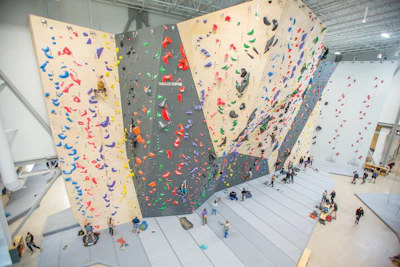
Indoor climbers reaching the highest hold on a wall may imagine themselves summitting a rock face on a picturesque Western mountain range, when in reality they’re 40 feet off the floor of a warehouse-style gymnasium in Cleveland.
But at Vital Brooklyn, climbers can genuinely feel the breeze through their hair as they reach the top of the gym’s outdoor, rooftop bouldering wall — with views overlooking the Manhattan skyline.
Walls such as the impressive one in Brooklyn bring the wow factor to any climber looking for a spot to test their skills, but the structure represents more than just an amazing architectural feat: this outdoor bouldering wall also represents the future of the sport with a focus on the outdoor setting, new premium materials, and accessibility.
Two of the industry’s leading companies, Walltopia and EP Climbing, spoke with Athletic Business to assess the future of the sport and break down trends in materials and manufacturing processes that are shaping the climbing industry today.
Plywood
For many recreation projects, facility operators and designers are faced with a big initial question: Will they use budget-friendly materials or splurge on higher-end hardware and infrastructure?
Climbing is the rare exception. In climbing, the least expensive building material is also the most popular and is used both in facilities projects on a tight budget and those looking to create a luxury experience.
Climbing walls in both college recreation centers and private, high-end gyms, like Vital, are built with plywood.
“I don’t see that going anywhere. That’s here to stay,” says Adam Koberna, president of Walltopia USA.
But the plywood revolution didn’t start until roughly 2010. Before that, Koberna says a lot of companies were using a “cement-plywood hybrid, or they were using a resin composite fiberglass material to make the walls look like real rock.”
In the U.S., a standard plywood climbing wall is made from a 21-millimeter-thick panel. Many of the plywood mixes, particularly those manufactured by EP Climbing, are made from Baltic birch.
“You can do an 18-millimeter panel. There are slightly fewer panels, so it has a slightly different climbing experience, but it is very close to the same, and it’s less expensive,” explains Bryce Benge, president of EP Climbing’s U.S. division, who notes that different types of wood can also determine a wall’s price point.
When asked why plywood gained an industry foothold in the first place, Koberna says, “It is way easier to maintain. It’s way easier to replace that stuff if something goes wrong. It’s also what the route setters and the climbers want. They want these really flat, open planes where they can bolt things to it, and plywood makes that really easy. It’s simple to do. The quality of plywood and the quality of the texture has advanced so much that it’s really good stuff.”
Benge also notes the ease of route-setting that plywood offers facility owners.
“You have a T-nut every 6 square inches,” he explains. “In a climbing wall, every hole in that wall is a place to put a handhold. In an older rock wall, you may only have a T-nut every 8 or 12 square inches, so the ability to iterate and change the routes over time allows users to get more variability and interest, and owners are able to have a longer life out of the wall.”
From price point and design flexibility to ease of maintenance, plywood has planted its flag within the industry, and Koberna notes that because the building materials from wall to wall are so similar, differentiating an average climbing wall from a luxury model “comes down to aesthetics.”
“We just did this bouldering gym in Denmark that is all bamboo,” he says. “It’s still wood, but that woodgrain look is what we are doing in a lot of gyms, with black accents. That pops really well. It looks higher-end. It’s the same materials, but it comes down to the design element and the aesthetic element.”
Koberna admits, however, that aesthetic choices will differ between collegiate and commercial customers. Each audience is looking for something different, but the materials by and large remain consistent.
 Photo by Madeleine Chan Stanley courtesy of EP Climbing
Environmental impact
When manufacturing and designing climbing walls from natural materials such as wood, sustainability is at the forefront of the conversation.
“EP has made a real commitment to sustainability and ethical sourcing,” says Benge.
For EP, that means taking an in-depth look at the origins of their materials, even from a geopolitical standpoint. Benge explains that Baltic birch primarily comes from the Baltic region and, more importantly, near the front lines of the Russia-Ukraine war.
“There’s a lot of Baltic forests around there, but so much of that is Russian-owned. As the war in Ukraine developed, there were many sanctions on Russia. That forced us to take a deeper dive into our supply chains,” Benge says. “Which exact mills was our product coming from?”
After a closer look, Benge says that EP is even more confident about the environmental and societal impact that the company’s material sourcing has on the industry, but sustainability hasn’t stopped at supply chain investigations. “When you dive deep into a supply chain, you start seeing opportunities and different potential products out there,” he says.
That deep dive led the team at EP Climbing to investigate new kinds of wood as alternatives to the Baltic birch, including Eucalyptus.
“Not that Baltic wood is not sustainable,” says Benge, “but there are other trees that renew faster, forests that are able to regrow really quickly, and other wood species types that are marketed or seen as a bit more sustainable. The ability for us to integrate some of those wood types into the wood climbing wall is a focus. You have to obviously still keep the performance and the quality. We don’t want to compromise all of that. So, how do we integrate pieces of the plywood and make them a more sustainable type of wood. Eucalyptus is a really good example. There has to be a hybrid wood that allows you to get the vast majority of the benefits of the Baltic birch, but also have some of that more sustainable material in there.”
Budgeting
Despite categorizing plywood climbing walls as a budget-friendly option, the process of renovating or building a climbing wall still comes with a price. That said, both Koberna and Benge can identify ways in which the industry offers lower-cost alternatives and innovative products to keep gym owners on budget and on trend.
EP Climbing often works on climbing wall refresh projects, particularly in college recreation centers where the wall is in need of an update but facility operators don’t want to invest in all-new construction. “You clean it, potentially repaint it, put new anchors in it, new ropes, a new set of equipment, new handholds, and it essentially looks and performs like a brand-new wall,” Benge says. “Clients have found it really successful to just do that in a recreation facility. People start looking at it again, like, ‘Oh, that was the old, dark, dirty wall over there, but now it looks brand new. Let’s check that out again.’ ”
The refresh could be a promising alternative for facility owners who, Koberna says, often underestimate the demo and the complexities of engineering a new wall.
Benge agrees, saying, “That’s a pretty in-depth project and a lot of people don’t think about the fact that when you do something like that, you may have to shut down part or all of your facility for a number of weeks.”
And while Koberna has seen clients go above and beyond to find a budget-friendly alternative, there are limits. “We have a few people who bought used walls that are taken down and they try to put them in a new facility. It’s almost impossible,” he says. “You have to have almost the same size and the same kind of opening. You have to have the same kind of footprint to make it work.”
“There are so many different options out there, and there’s not one solution for everybody,” adds Benge, who offers one key suggestion for keeping projects on budget: standardized climbing walls.
“The other thing we talk a lot about with price point and budget is a standardized climbing wall,” he says. “Getting away from the fully custom and getting into a product line that is made out of the Mozaik material but is predesigned.”
Mozaik is EP’s state-of-the-art, premium climbing wall material. Most of the projects EP works on are custom builds with the Mozaik material, but Benge says going with a standardized wall allows facilities to build a rope or bouldering wall with multiple lanes in all predesigned components.
“It’s a little bit less flexibility, but it allows the price point to be quite a bit lower, because we are able to involve different industrialization techniques at the factory to standardize things, and there’s less custom design work, so it’s fewer man-hours,” he says. “Different things like that on the front end allow it to be at a lower price point, but you still get the functionality of an amazing climbing wall at the end.”
With the option of installing standardized walls, facilities that didn’t want to spend several hundred thousand dollars, but who wanted to add a climbing feature, could “maybe now do it with $100,000,” says Benge. “It allows us to give more people access to climbing around the country and the world.”
Digitizing climbing
Popularizing climbing around the world and in the U.S. is exactly what Koberna sees as the benefit to digitizing climbing walls.
Digital climbing boards are the latest trend to rock the industry. From the Moon Board and the Kilter Board to the new Quantum Board, these space-saving, cost-efficient climbing boards allow users to set their own routes, compete with other climbers around the world and practice their skills without needing a belay system.
“There are about six boards on the market. They’re all doing the same thing with a little different flavor,” says Koberna. “We have gyms that are all LED lights, and it’s the same feature that is in Germany as is in California, so you can compete on the same route with people on the other side of the world. That is so cool, right? It’s like Strava for climbers.”
To Koberna, the digital climbing revolution is ripe for use in the college setting, where space and budgets may be limited.
“If you’re tight on space, just put in two or three boards,” he says. “I think with a racquetball court, it’s perfect. The ability to purchase it and self-install it means that we’re not in a construction process, and the purchasing department probably has the leeway without having to do crazy bids.”
Boards are seen as a preferred court-conversion option compared to taller walls. “The racquetball court is roughly 20 by 40 by 20,” Koberna says. “It’s not a great space to have tall walls. If you do it on both sides, people are running into one another.”
Not only are the digital climbing boards popping up in college rec centers across the country, but Koberna says Walltopia is now working with clients to build entire facilities that only offer boards — with no tall walls or bouldering.
“One opened up in the Northwest. They did 14 boards in a retail space,” says Koberna, who describes another design in progress in Bishop, Calif., where there is “a really strong climbing community, but people are just in and out. So, [the client] wants to build a boardroom, that’s it. You’ll make a lot of money doing that.”
 Photo by Madeleine Chan Stanley courtesy of EP Climbing
Getting outside
Digital boards stand to revolutionize the climbing industry, but in a lot of ways, climbing is also focused on going back to its outdoor roots. Says Benge, “Outdoor climbing and the ability to bring artificial climbing outdoors continues to be a growing market.”
Gyms like Vital Brooklyn are prioritizing unique, outdoor climbing spaces in part because the latest plywood construction options make maintenance and renovation so affordable.
“People are even using that stuff outside,” Koberna says. “It only lasts seven years outside, then I’ll just re-skin it. It hasn’t been around long enough to do that but people are buying walls outside prepared to do that.”
While not every commercial climbing gym can boast the same breathtaking views as Vital, Benge believes that outdoor climbing will continue to grow in both parks and outdoor recreation facilities, as facility operators capitalize on both the popularity of the sport and underutilized outdoor spaces.
“There are some regions where you don’t want to do it,” admits Koberna, noting that high-heat environments could be just as detrimental to outdoor climbing walls as places that see heavy snowfall. “We use a water-resistant plywood, and that helps keep it from deteriorating really fast, but the sun is just as dangerous or just as volatile for that material as water. You have a different issue of deterioration. The handholds go really quick because that’s a polyurethane. You can put an additive in that to make it UV resistant, but it goes quickly, so you’ll be replacing your handholds a lot.”
To capitalize on the outdoor climbing boom, EP Climbing brought Mozaik XP to market and installed it at the Vital Brooklyn rooftop. It’s the same plywood mixture as the standard Mozaik material, but it also uses a fiberglass composite to reduce the effects of moisture and airborne contaminants, Benge explains.
“It’s not that it doesn’t degrade at all, but it’s going to last a long time,” he says. “It gives you the same customizable designs, modern route setting, ability to hold competitions — all the things people do in a modern, indoor climbing facility — and bring it outdoors.”
While outdoor climbing and the digital climbing revolution push the sport and facilities forward, Koberna says that, above all, “Climbing in the Olympics is massive. That’s a game-changer. It’s going to change everything when it comes to access.”
Part of that accessibility milestone may come directly from these new innovations, including free-access, outdoor bouldering walls, digital boards lowering the cost barrier in college recreation centers, and sustainable products that will allow climbing walls to continue to be built with high-quality materials.
Says Benge, “There’s a lot of potential change out there.”