Jami Kubik wasn’t accustomed to catching passes while negotiating a field covered in mud. She wasn’t accustomed to catching footballs, for that matter.
But there was Kubik, the 1994 Miss Nebraska Basketball star who had started all 33 games at guard for the University of Nebraska women’s basketball team her senior season, her eligibility now exhausted, running receiver routes for NU’s club coed flag football team at a national tournament in New Orleans. Kubik was joined by a former basketball teammate and an outgoing volleyball player as three women with NCAA varsity sports experience who helped round out a roster that advanced all the way to the tournament’s title game.
“The fact that we didn’t have direct experience with flag football, we felt pleased that we made it to the championship,” says the current Nebraska associate athletic director for financial reporting, who goes by the married name Jami Hagedorn these days.
In addition to her accounting duties within the athletic department, Hagedorn will oversee Nebraska’s fledgling women’s flag football program, launched as the first Power Four varsity program on the same day (Jan. 21) that the NCAA announced it had added flag football to its Emerging Sports for Women pipeline. Not surprisingly, Nebraska also became the first Power Four school to offer a flag football scholarship (Jan. 24), though it did so roughly a month before naming a head coach (Feb. 26), and years in advance of the Huskers officially beginning competition in spring 2028.
That leaves Liz Sowers, who led Ottawa (Kan.) University to the past five NAIA women’s flag football championships, plenty of time to fill out a roster of 25 once she officially assumes her new duties in Lincoln on June 1.
The sport’s talent pool is filling fast, and it all starts at the youth level. According to RCX Sports, the official operating partner of NFL Flag, 827,322 youths ages 5 through 17 participated in its flag football leagues in 2025 — a 35% increase from two years prior. Under RCX’s watch, all 32 NFL franchises support regional tournaments, culminating in NFL Flag championships broadcast by ESPN and ABC each July. The NFL, which launched NFL Flag 30 years ago, joined the International Federation of American Football in lobbying the International Olympic Committee to debut flag football at the 2028 Summer Games in Los Angeles, and “The Shield” plans to launch men’s and women’s professional flag football leagues prior to that.
“There’s been a lot of momentum and power in the marketing and support that the NFL has put behind flag football as a whole,” says Jade Strawberry, chief of staff at RCX Sports, which reports that coed teams comprise the bulk of its youth participation, but in gender-specific competition, girls outnumbered boys 174,260 to 28,180 last year. “There’s a true pathway for these female athletes to play flag football, so I think we’ll continue to see growth.”
According to NFHS chief executive officer Karissa Niehoff, each of these developments helps explain the exponential surge in participation at the high school level. NFHS, which governs girls’ flag football only (for now), reports that 68,847 girls participated in the sport during the 2024-25 academic year — a 60% increase from the previous year and a 388% increase since the first post-pandemic participation survey was taken in 2021-22. And that’s with only 17 states currently sanctioning championships in the sport. Another 16 states are in the piloting stage, six will be voting this year and six are not far behind in terms of interest, according to Niehoff, who says no state is outrightly opposed to flag.
“We all love football,” she says. “For girls, it’s a chance to be athletic and strategic, and to get out there and start something with people who are also starting at the same time. I think girls — just like boys — want to be athletic, and this is a great sport for them.”
“I did really enjoy it,” Hagedorn says of her limited flag experience at the collegiate club level. “I wouldn’t say I liked it as much as basketball, just because I didn’t have a history with it. I think the great thing about the NFL providing these outlets and avenues for kids at a young age is they’re going to grow up loving the sport.”
Low barrier to entry
Eric Mayes spent more than six years at the NCAA before joining USA Football in 2019. He’s now entering his sixth year as the national governing body’s managing director of high performance and national teams and has served concurrently as general secretary on IFAF’s governing board for the past 17 months. Few people can better assess flag football’s meteoric rise.
“In many ways, it’s unprecedented,” Mayes says. “I worked with the NCAA before joining USA Football, and I can speak at least to the emerging sport process. The number of member institutions willing to navigate that application and add women’s collegiate flag compared to other sports that have been through that program — women’s wrestling and others get there, but the pace at which they get there is not as fast as what we’re seeing in flag. It is just staggering.”
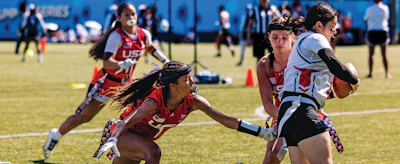
It’s not hard to see the attraction. Flag football prohibits purposeful physical contact, such as blocking, tackling and stiff-arming. There’s also no kicking — and that goes for the ball, too. International flag is a five-on-five game played on a field measuring 70 yards long (including endzones) by 25 yards wide, while high school and collegiate competition is seven-on-seven, using field dimensions that may vary (60-80 yards long, 25-40 yards wide). Girls and women play with a smaller ball, representing perhaps the biggest expense within the mix of jerseys, flag belts and flags that a start-up program will incur (assuming players provide their own mouthguards and cleats). According to Hagedorn, adidas is contractually obligated to outfit any new Nebraska varsity sport, so no financial worries exist for the Huskers even on the footwear front.
“Right now, we’re figuring out places within our current facilities where we could house the locker room and coach space,” Hagedorn told AB in February. “Facilities are another thing you have to figure out. We’re lucky here at Nebraska. For fields, we have a few options. We have a soccer stadium [grass] that we think would fit nicely, but if need be, we have the football stadium [synthetic turf].”
“The good thing about flag is there’s a very low barrier to entry,” Mayes says. “Your field space can be used with what already exists on campuses — whether that be a football field or a soccer field. Depending on the discipline of flag, you could put three flag football fields on a traditional soccer field or two on a football field, so it’s very advantageous that way when schools are thinking about adding it.”
Hagedorn says Nebraska is still figuring out what its annual flag football budget will look like, but compared to the Huskers’ varsity tackle football program, it will seem modest, if not minuscule, at least at the start. Tackle commands a coaching and support staff of 75, according to the football directory at huskers.com. For now, Nebraska flag will feature a full-time staff of two — Sowers and her twin sister Katie, who will serve as associate head coach. According to Hagedorn, flag football will share additional support positions — an athletic trainer, for example — with other NU varsity programs.
Sowers brings playing experience, including for both the USA women’s national flag and tackle football teams, to the coaching ranks, where she has amassed an 88-8 record as a head coach. That resume makes her a rarity in today’s flag landscape — a situation USA Football hopes to rectify. “Flag has been very recreational in nature up to the last five to 10 years, where many teams were just operating without coaches,” Mayes says. “At USA Football, we took it upon ourselves to try to develop a pathway for coaches to get into flag or, if they’re athletes, to recirculate into coaching, so we could build our bench, so to speak, in the coaching space. We’ve made tremendous strides with that over the last five years.”
At least one of Nebraska’s Power Four peers has expressed reluctance to add women’s flag, though not due to a dearth of on-field leadership candidates. Speaking at his annual town hall Feb. 4, University of Texas athletics director Chris Del Conte made it clear during a back-and-forth with a flag football advocate in attendance that adding the sport is not on his list of priorities, citing travel expense projections fueled by a lack of proximate competition as a main reason. That excuse is not likely to age well — not in football-crazed Texas or anywhere else, as evidenced by the near-daily headlines announcing new collegiate programs. According to the Austin American-Statesman, Del Conte told his town hall audience that he wanted “to be great in 21 sports [that Texas currently sponsors], let the dust settle and see what happens. If I miss the boat, if I’ve got to catch up, I promise you, I’ll catch up quick.”
“Depending on how many institutions or schools are playing flag, you’re going to have transportation costs getting teams from one school to another,” Mayes admits, adding, “A lot of times that is lessened because flag football often occurs in tournaments, so you can fit more than one game in a day or a weekend.”
Make the team, stay in the game
The apparent latent demand for an alternative to tackle football, particularly among America’s adolescent girls, has surprised even Niehoff, who points to California, where participation just doubled in a single year.
“We’ve learned that in the high school space, about 50% of the young ladies who are playing were not engaged in another high school sport, which is incredible,” she says. “Another piece to that, though I don’t have any data to prove it, when kids are engaged in clubs at such early ages, and they specialize in basketball, soccer, softball or whatever it is, by the time they get to high school, they’re either burned out or they’re not going to make the team. Flag is an opportunity to make the team.”
That said, demand is so great at this moment in time and in certain parts of the country that participation isn’t necessarily guaranteed. “We had a school in North Carolina that started a flag program. They had over 180 girls try out, and they could only pick 32,” Niehoff says. “It’s already becoming selective.”
Meanwhile, NFL Flag is seeing its universe expand by approximately 100,000 youth participants year over year. “Accessibility, affordability, inclusivity — that’s just the RCX mission, because we understand some kids’ families can’t even afford ‘affordable,’ ” says Strawberry, who has been with RCX Sports since its inception in 2020, when it took over NFL Flag operation from USA Football. “Our goal is to make sure every child has the opportunity to play.”
When asked if flag is the future of youth football, Mayes says, “I think flag is a component of youth football, and it’s a great one. It’s a great developmental entry point for young boys and young girls who are entering into the sport of football to learn the fundamental techniques of the game and then transition to tackle and or stay in flag, if they elect to do so. Young children playing flag football can only help the overall participation in the game, so it’s a component of the future of football.”
Is there a chance enough boys will stick with flag to justify men’s flag football becoming a Division I varsity sport? Hagedorn, for one, doesn’t see that happening, at least not in Lincoln. Not yet. “I would never say never,” she says. “I know men’s flag is also growing. They obviously are aiming to have professional leagues for men’s and women’s flag. It’s going to just depend on the individual school, but the current climate we’re in, I would say no, because adding a men’s sport then skews your Title IX numbers again. At this time, adding a male sport just would not make sense for Nebraska.”
Hagedorn says being the first Power Four school to sponsor flag football and offer a flag football scholarship wasn’t necessarily a distinction on the minds of Nebraska administrators, but it does align with the school’s leading-edge approach to gender equity. “One of the great things about adding this is it’s going to give a whole new set of young female athletes a different avenue that wasn’t there before to pursue their sport at the highest level and receive scholarship dollars for it,” Hagedorn says. “The fact that they have that option now is wonderful for all female athletes who love flag football.”
Mayes estimates 90% of his professional focus is now on flag, at least as USA Football prepares for the Olympics in two years. He sees the ultimate international stage as the sport’s next accelerant. “I think five, 10 years from now, especially with what we hope is a successful showcase for the game in Los Angeles in ’28, but also based on the staggering growth we’re seeing now, we could find a situation where women’s flag football is one of the most popular women’s sports in the United States,” he says. “It’s not outside the realm of possibility that women’s flag football athletes become household names.
“There’s a pathway now for girls to stay in the game, all the way up to the highest levels — from college scholarship opportunities to professional leagues to the Olympics. From a governing body standpoint, that’s what you want to see. It’s a great formula for expansive growth.”
Tackle Still on Solid Footing
Could flag football become so popular that it trips up the forward progress of the traditional tackle game?
“It’s a big question, and I get why people have it,” says Curtis Peterson, managing director of sport development and growth at USA Football. “We look at football in a very broad sense. We work with youth organizations — some are flag only, some are tackle only, some are both and some are adding flag for the first time. Football is big enough for tackle and flag.”
Peterson coaches his 10-year-old son in both disciplines. When asked if his child is a better tackle football player because of his flag experience, Peterson says, “I believe strongly that he is, and the other team members that I’ve coached are better players overall, as well.”
The reason, according to Peterson, is that receivers learn to run crisper routes, while defenders are forced to develop skills in a non-contact setting. “You can’t play press man coverage and really get physical with the receiver,” he explains. “You have to really hone your techniques for playing specific types of coverage and not make contact. And that’s hard.”
Peterson even draws parallels between wrestling ball-carriers to the ground and ripping a flag from their waistline. “Within our Football Development Model, we came up with skill progressions for tackle, and those now mirror what they are for flag,” he says. “We call them the 5 Fights — track, prepare, connect, accelerate, finish. For tackle and for flag, you’re pursuing a ball-carrier at the right angles with the right leverage. You’re making the right approach, and you have to make contact or pull a flag at that right moment. You do it too early or too late, you’re going to miss the tackle or flag pull.”
Adds USA Football director of communications Ryan Anderson, “One thing the FDM does that is beneficial is that if kids have hesitancy to play tackle football initially, there’s a way for them to find an entry point that is comfortable. Some kids will choose to progress from flag to tackle. Some kids will choose to stick with flag, and that’s totally fine. Our goal here is to make sure that youth participation and the growth of the game continue to be consistent, and that does not make one discipline less important than the other. We’re focused on both.”
As much as the NFL is focused on flag, it has provided unprecedented amounts of grant money in support of tackle football at the high school level, according to NFHS chief executive officer Karissa Niehoff, who adds that tackle participation numbers have rebounded from a recent dip attributed to well-publicized alarm over potential head trauma, as well as the COVID-19 pandemic.
“The NFL really is concerned that we don’t lose numbers in high school tackle,” Niehoff says. “That’s why they’re supporting us more than they ever have before, because we are the sport. This is where kids play tackle.”
And they’re playing tackle in record numbers. “We’re back up over a million — the highest ever total participation,” says Neihoff, attributing the surge to safety-related changes to education, rules and regulations. “We’re still seeing concussions, sure. That’s a risk we take in the sport of football. But I think the confidence that participants in the game are better protected has helped families decide, ‘Yes, we’ll let our child play.’
“We love our football. I know America is never going to give up tackle football.”