There was a time not so long ago when security at an athletics venue meant a gate attendant, a ticket stub and the reasonable assumption that nothing bad was going to happen. For most of the industry’s first few decades, that was enough. Or at least it felt like it was.
It wasn’t, of course. It just took a series of defining moments to make that clear.
“9/11 changed the culture of people accepting security,” says Brandon Allen, research director at the National Center for Spectator Sports Safety and Security at the University of Southern Mississippi. “It gave venues the ability to enhance their security without a whole lot of pushback. Standard operating procedure pretty much changed across the board.”
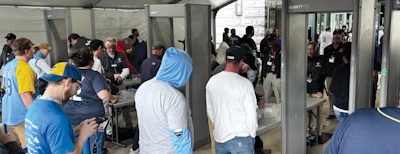
That shift from security as an imposition to security as an expectation is probably the single most consequential development in venue security over the past 50 years. Before it, measures that would now seem unremarkable required significant justification. After it, the burden of proof flipped. No one questions why a bag gets checked at the gate or a credential gets scanned at a restricted entrance. The assumption is that those measures exist for good reason — to enhance individual and collective safety — and that assumption has held.
The pattern
What made Sept. 11, 2001, different from the individual tragedies that preceded and followed it was permanence. The industry’s response to discrete events — school shootings, stadium crushes, bomb threats — has followed a more uneven arc.
Allen is direct about it, noting that real investment in safety measures tends to follow high-profile incidents, but the urgency dissipates. The reasoning is familiar to anyone who has sat in a budget meeting where stakeholders doubt the likelihood of it happening here, to us, and it begins to feel all the more remote once the news cycle moves on. Says Allen, “Six months after the fact, the resources aren’t there and the priorities kind of drop back down.”
That drift is one of the more persistent challenges in the field — not a failure of awareness, exactly, but a failure of sustained will. The knowledge of what should be done often outpaces the commitment to doing it. Events shock the system into action. Time gradually returns it to equilibrium.
The tragedy of 9/11 broke public expectation. The security measures it normalized — screening, credentialing, controlled access — became the baseline. Those measures have not receded. If anything, they’ve continued to become more robust in all aspects of public life. The scale and visibility of the terrorism event made forgetting impossible in a way that more contained tragedies, however devastating, simply have not.
The professional edge
Not all venues have responded to that baseline equally. Allen, whose organization recently completed a sweeping industry survey, sees a significant divide between professional and collegiate sports venues, with professional sports holding a clear advantage across nearly every dimension of safety and security best practices. “Professional sports have a leg up when it comes to the technology being deployed and the innovation coming in,” he says, noting that the NFL has been particularly aggressive, transitioning to facial recognition authentication for staff credentialing across its venues. Major League Baseball and other leagues are following.
“They’re taking the gamble and betting that spectators are [also] going to accept this technology,” Allen says.
Part of what makes that possible is leverage. At the professional level, resistance from individual patrons carries limited consequences. If one fan objects to a biometric scan, another will buy the ticket. Demand is high enough that venues can push the adoption of measures that might feel invasive in a different context. That’s the reality of the market, and it has allowed professional sports to move faster than virtually any other public sector — save, perhaps, the airline industry — on security innovation.
The collegiate gap is meaningful and, Allen suggests, not entirely surprising. Resources, organizational capacity and institutional priorities diverge significantly from the professional model. He says the survey data underscores the distance between where best practices point and where most collegiate venues actually find themselves to an extent many in the industry might not expect or appreciate.
What’s coming
If the past 50 years were shaped by threats that arrived suddenly and forced a reckoning, the next era may be defined by vulnerabilities that are already visible but not yet fully addressed.
Allen points to a striking figure from NCS4’s forthcoming industry report: only 25% of venues are currently scanning for chemical, biological, radiological, nuclear and explosive devices (CBRNE). The technology to do it exists. The deployment hasn’t followed. As the threat landscape evolves and bad actors grow more sophisticated, that gap represents meaningful exposure for a significant majority of the nation’s venues.
Beyond CBRNE, Allen identifies a cluster of emerging threats that, enabled by technology, is becoming cheaper, more widely accessible and — importantly — more capable.
Three-dimensionally printed, non-metallic weapons represent one front. Traditional magnetometers are designed to detect metal. A plastic weapon defeats that layer of screening entirely, and the barrier to producing one continues to fall as 3D printing technology becomes more affordable and widespread.
Drones, says Allen, represent another. Once a novelty at the perimeter of large outdoor events, they are acquiring more capability (and consequently appearing in this column with increased frequency) as consumer technology advances. Recent policy developments have begun to give venue operators clearer authority and better tools for mitigation, but the threat is still taking shape. How significant a factor drones ultimately become, Allen acknowledges, remains to be seen, but the trajectory is toward more, not less.
Cyber threats may be the most expansive category of all. They don’t announce themselves the way a physical breach does, and they cut across every system a modern venue relies on: credentialing, communications, access control, payment processing. “When technology is inexpensive and anyone can buy it, it’s always a threat,” Allen says. “When there’s no control or monitoring, anyone can get it and use it however they want.”
And then there’s the emerging intersection of cyber and physical in the form of deepfake technology sophisticated enough to fabricate credible threat scenarios, including swatting — that is, creating false reports designed to send law enforcement responding to a venue that isn’t actually under attack. The disruption alone carries real costs, and the potential for more serious manipulation of security response is a concern the industry is only beginning to fully comprehend, much less contain.
The long view
Fifty years ago, the conversation happening now would have been nearly unrecognizable to most venue operators — if not dismissed as tinfoil hat talk. The threats were different, the technology didn’t exist and the cultural expectation of what a venue owed its patrons in terms of safety was a fraction of what it is today.
What hasn’t changed is the underlying dynamic: something bad happens, the industry responds and the baseline shifts. The question Allen’s research keeps raising is whether the industry can get ahead of that cycle and whether the next generation of threats can be met with preparation rather than reaction.
The record on that is mixed. But the urgency, at least, has never been greater.