One substitution precipitated another. Texas Tech guard Christian Anderson strained a muscle in his groin when his foot slipped on an inbounds play during a Big 12 Conference quarterfinal loss to Iowa State in March, ending Anderson’s tournament eight and a half minutes before it ended for his replacement and the rest of their Red Raider teammates.
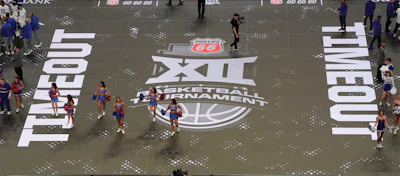
The Big 12 then decided it was going to swap the playing surface at T-Mobile Center in Kansas City from the eye-catching LED-illuminated glass court it had installed for the event to the hardwood floor used during the previous year’s conference tournament — just in time for the 2026 semifinals and championship game.
The switch did not go unnoticed. How could it? One day, the court is operating like a video board, with internally generated sponsorship and spectator engagement graphics. The next it’s back to static but reliable paint and stain.
New frontier
Massive center-hung scoreboards. Ribbon boards on the facias of upper decks. Dynamic courtside scorer’s tables. It only makes sense that the next stop on the fan experience frontier would be the greatest focal point an indoor sports venue can offer — its playing surface. But unlike those other areas within an arena, a court has to meet player expectations in terms of its flexibility, area of deflection and coefficient of friction — and without being a bright and busy distraction underfoot. It’s a tall order, for sure, and one German-based ASB GlassFloor seems determined to fill.
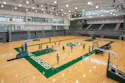
The company’s ASB GlassFloor Athletes Lab in Orlando, Fla., has been used by visiting NBA players during their own training, leaving one to try to imagine a greater test for — and endorsement of — the technology than the world’s best and highest-paid players willingly pounding the surface with basketballs and their finely tuned 200-plus-pound bodies. It made U.S. appearances in 2024 at the NBA All-Star weekend at Lucas Oil Stadium in Indianapolis, as well as inside the University of Kentucky’s Rupp Arena for Wildcat basketball’s annual Big Blue Madness, but the 2026 Big 12 tournament was considered the floor’s domestic debut in terms of actual game competition. Designed to also accommodate other activities, including volleyball, the floor’s game lines can be changed in an instant.
Sports Business Journal reported in February that the Big 12 and ASB GlassFloor were looking to start at least a three-year tournament relationship, but that now appears to be as up in the air as an opening tipoff. The day after the 2026 tournament’s surfacing turnaround, conference commissioner Brett Yormark appeared on ESPN’s The Pat McAfee Show to say he is “still a lover of the LED court,” that the Big 12 will “stay in touch” with ASB GlassFloor, but that he told the company’s leadership they needed to “go back to the lab” and “refine some things,” SBJ reported.
As to exactly why the Big 12 bailed on the floor in the middle of its men’s tournament (particularly after completing the entire women’s bracket on the same surface), and what impact that had on any agreement terms that had been transacted, the conference wouldn’t tell AB. It declined our interview request other than to explain that the T-Mobile Center still had the 2025 hardwood tournament court in storage and that it could be installed overnight. Yormark’s statement at the time: “After consultation with the coaches of our four Semifinal teams, I have decided that in order to provide our student-athletes with the greatest level of comfort on a huge stage this weekend, we will transition to a hardwood court for the remainder of the Tournament. We look forward to a great Semifinals and Championship Game.”
To gauge ASB GlassFloor’s reaction to that decision and the company’s strategy moving forward, AB forwarded a list of 20 questions through its public relations firm, which responded that ASB GlassFloor America CEO Chris Thornton is not conducting any more media interviews pending results of new testing on the surface. Those test results were not available as this issue of AB went to print. The company had previously declared that the ASB GlassFloor used during the Big 12 tournament holds Level 1 certification from FIBA, the highest international standard for professional basketball playing surfaces.
“During the event, we observed more player inconsistencies at T-Mobile Center than at other venues using ASB GlassFloor,” Thornton said in a statement. “We are conducting a full investigation into all possible contributing factors. This will include scientific testing and review. Athlete health and safety remain our highest priority.”
Big 12 coaches favoring caution included Bill Self of Kansas and Houston’s Kelvin Sampson, who seemed to empathize with Yormark’s motivation on both sides of the replacement equation. “I think commissioner Yormark’s intent was to broaden the scope, think outside the box and that was probably the right decision,” Sampson said, as reported by CBS Sports. “And I’m sure after what the narrative is now, he’ll make the right decision. If this was a concert tonight and we had a game tomorrow, no different than that. ... Nobody had an advantage or disadvantage, but I think for our league, he’ll make the right decision.”
“I won’t comment on the glass courts,” one sports surfacing manufacturer told AB, adding, “I think the commissioner did a good job.”
Wood manufacturers weigh in
AB reached out to several wood flooring manufacturers for their take on LED court technology in the wake of what transpired in Kansas City.
“We share the view of many fans who commented on the Big 12 Conference incident: glass floors can make for an entertaining spectacle, but we have always struggled to see their justification in competitive settings where athlete safety and performance are paramount,” one manufacturer says. “Our opinion hasn’t changed. If anything, recent events have confirmed what we already believed. The issues seen at the Big 12 Conference suggests this is not a problem that better engineering will easily fix. Glass floors have consistently struggled to deliver the traction that competitive sport demands. When players are slipping, straining muscles and leaving the court with migraines, the surface has failed the most basic test. If athletes cannot fully trust the surface, they will adjust their movement, and that affects both performance and injury risk. And this problem is only likely to worsen over time.”
This manufacturer adds that the floor’s performance in the form of “the LED advertising, the sponsorship opportunities, the visual spectacle” can never take precedence over player performance. “In our view, that is not a worthwhile trade-off when the consequence is players straining muscles because they can’t keep their footing or leaving the court with migraines from the heat and glare of the floor. The game suffers. And when the game suffers, the fans follow, no matter how much the floor flashes.”
Others appear to be slightly more open-minded.
“The LED glass floor is a significant technological milestone,” says another wood flooring industry insider. “We view it as a high-end showcase disruptor rather than a replacement for traditional systems. It has successfully challenged the industry to think beyond the physical surface and consider the court as a digital canvas. It may one day fundamentally change how fans interact with the game. It introduces a new revenue model for venues through dynamic sponsorship and real-time data visualization and has accelerated the conversation around what a modern arena looks like, pushing all manufacturers to explore how technology can be integrated into the playing surface.”
That source also points to considerations surrounding the conversion from one sport to another. “Having the ability to change game lines on the fly to host basketball, volleyball and even non-sporting events is a huge plus. But that feature is only useful if the playing surface is safe for the athletes, and the consistency of play is not affected,” the source says, adding, “The amount of time to install a maple floor is considerably faster than the time it takes to install an LED floor, so the installation time will need to be drastically reduced for LED floors to be considered a viable option in facilities where the floor is installed and removed regularly.”
“We do not see LED flooring as a market disruptor but as potentially complementary to existing indoor flooring options,” a different hardwood flooring manufacturer told AB, with the following caveat: “Any technological advancements in sports equipment — including the sports surface — should protect the safety and wellbeing of the athletes and the integrity and quality of the game. Courts that can change design may provide additional marketing and entertainment opportunities, but we feel strongly that the focus of the game should be on the outstanding players and coaches of the sport. Any aspect of the court that distracts players during play or prevents them from performing at their best should be minimized or eliminated.”
When asked if it would ever consider entering the LED glass floor market, this same manufacturer adds, “Our company’s focus is on supplying floors that promote the safety, comfort and performance of athletes and performers. If LED flooring can enhance these aspects of play, then we would consider offering this type of technology.”
What do the players themselves have to say? After all, strains and sprains have been occurring on basketball courts of all kinds since the sport was invented nearly a century and a half ago. Opinions on the LED court range from NBA players calling it “cool,” “really nice” and “dope” to Kansas State forward Taj Manning claiming in March, “It’s a bad floor. They shouldn’t bring it back.”
Christian Anderson, the Texas Tech guard whose injury appeared to be the tipping point for the Big 12, admitted the court was “a bit slippery.”
“I think I just kind of misstepped or did a movement that caused me to slip and kind of ended up in a little unnatural position,” Anderson said, as reported by KSHB in Kansas City. “That’s what it was.”
It should be noted that Anderson’s injury was not severe enough to keep him from playing 37 minutes in the Red Raiders’ NCAA tournament opener March 20 — eight days removed from his early Big 12 exit.
As for ASB GlassFloor, its next steps should become clearer in the coming weeks and months. The company’s lab in Orlando is expected to be as busy as ever as it continues its quest to combine the best of all worlds — competitive efficacy for athletes, enhanced revenue opportunities for organizations and unprecedented entertainment for spectators. “It is well documented that NBA teams have used the ASB GlassFloor Athletes Lab in Orlando for training and evaluation,” Thornton said in a statement to AB. “The facility was developed in collaboration with the NBA and serves as its dedicated testing environment where NBA teams and performance staff can train on the surface, compare it directly to hardwood, and provide real-time feedback.”

Projection’s Profit Potential
Team logos that appear to pulsate at center court. Three-point arcs that look electrified. Highlight video during player introductions or a hall-of-fame induction ceremony. A sponsor car dealership’s hottest make and model roaring across the floor to synced-up sound effects.
For venues looking to animate their playing surfaces, options abound — and at all levels of competition.
AB first reported on high-definition, three-dimensional projection technology in April 2014, but the high-powered Quince-manufactured system favored by NBA facilities to throw images great distances from a dozen projectors is likely out of reach for high schools and some colleges.
Dustin Lehner was watching his teenaged daughter play in a 2025 Tennessee regional basketball final north of Nashville last year when he was first exposed to the possibilities of court projection. “I was sitting around a number of other parents and boosters, and we were all like, ‘What is that? That is so cool!’ And then I took it upon myself to just kind of chase it down,” says Lehner, who within months joined manufacturer Luxedo as its chief marketing officer. Not surprisingly, his daughter’s school, Columbia Academy, installed the technology this year — becoming one of 150 high schools across the country to do so since last August.

Luxedo systems employ a minimum of four projectors at an entry-level investment of $50,000, Lehner says — a fraction of the cost of a pro-level system requiring extra brightness to deal with distance and ambient arena lighting. Graphic artists, including students, can use a variety of existing software platforms to create content, which is then pushed through a proprietary portal to Luxedo’s overhead projectors. Shows can be run from a laptop or even a cellphone. “The output is now a minute-long pep rally show or a one-minute pregame show for the volleyball team, and you actually have students creating that output,” Lehner says. “We’ve seen a number of schools think that that’s really the best utilization of the system — to allow their broader student population to play a part in the co-creation.”
One school put its fire-breathing dragon mascot on the court so it could engulf the gym’s video and ribbon boards in flame graphics, too.
Because shadows only exist directly underneath those standing on the surface, projection can even be used to demarcate temporary playing boundaries during a pickleball fundraiser, for example. Dark, permanent markings on a court in the form of painted logos or free-throw lanes do impact projection, but shows can animate around these areas or incorporate them by design, Lehner says.
Sponsorship clearly helps make the system an easy sell for schools — from a flag-waving availability for a full 90 seconds during the national anthem to the 30-second “sizzle reel” celebrating the program before starting lineup intros become their own dynamic thing. “I had one coach say, ‘Hey, I don’t want to show just my five starters. I want to highlight all 12 boys,’ ” Lehner says. “We took all of their photos and videos from media day and did sets of three or four boys with their names and numbers on the court for a good 10 seconds so that every kid on the team gets a little bit of love.”
Rapid return on investment has many administrators enamored with court projection.

“We’re seeing some schools basically get that return of those dollars in one to two years,” Lehner says, adding that Luxedo even provides install-now-pay-later programs. “That way, they can utilize the machines — once they’re in their rafters — to generate the money to then pay off the balance. The sooner they get it in, the quicker they can start generating revenue.”
Of course, it’s about more than revenue-generation, Lehner adds.
“The players on the court and the students in the stands are used to digital, they’re used to multimedia, they’re used to immersive environments. This is just the next step of taking what is an incredible space — a gymnasium — and now saying, ‘How do I take this and really create memorable experiences?’ ”