The numbers don’t lie. Campus recreation centers across the country are seeing students shift from cardio to strength training. At the University of Cincinnati, the number of elliptical machines dropped from 25 to eight without affecting demand. At Duke University, students are gravitating toward powerlifting movements that barely existed in campus fitness culture a decade ago.
This shift has prompted a wave of weight room renovations that go far beyond simple equipment replacement. Universities are fundamentally reimagining their strength training spaces and investing millions to accommodate changing workout preferences. The driving force is clear: today’s college students want to lift weights, and recreation departments are scrambling to provide the square footage and equipment they need.
The transformation reflects broader fitness culture changes accelerated by social media and streaming fitness videos. Students arrive on campus much like their varsity athlete cohorts, already familiar with compound movements and functional training concepts, expecting sophisticated equipment that supports their goals.
Two recent projects at Cincinnati and Duke illustrate both the challenges and strategic thinking required for successful weight room renovations. Both institutions faced similar problems – aging equipment, space constraints and surging strength training demand – but took markedly different approaches based on their unique circumstances.
Photo courtesy of the University of Cincinnati
Cincinnati maximizes space
At the University of Cincinnati, the rec center’s weight room renovation began with a simple recognition: they weren’t serving their students effectively. With only 11 squat racks for their entire 53,000-student population, the facility couldn’t meet demand during peak hours.
“We were underserved in strength,” says Traci Smith, UC’s assistant director of Fitness & Wellness. “We had 11 squat racks to serve our student population, and when I did some benchmarking across other universities, no school of our size had that few squat racks.”
The problem was compounded by Cincinnati’s urban campus constraints. Unlike universities with sprawling recreation complexes, Cincinnati had to maximize every square foot of its existing facility. Smith developed a multiphase approach that started small and grew into a comprehensive overhaul.
The first phase involved eliminating underutilized equipment, even premium pieces that some students used. “We had every single plate-loaded piece of equipment you could name,” Smith recalls. “And it’s like, all right, we don’t maybe need every single one if we want to be able to expand on additional pieces.”
Smith’s team tripled their cable machine capacity in the early phases, responding to student demand for versatile equipment. “It’s really interesting, the demand for cables,” Smith notes. “Students just really liked the versatility of it, and I think the loose structure of how people train for bodybuilding is still really popular with college students.”
The strategic decision to reduce cardio equipment proved prescient. “We started to say, ‘Cardio’s not as popular.’ The cardio that is popular are stair climbers and treadmills. The rest of it, yes, it’s nice to have, but the demand is for two primary pieces,” Smith says.
The final phase required the most dramatic change — relocating all cardio equipment to create a dedicated strength zone. This decision necessitated significant electrical work, as the optimal location for cardio lacked power infrastructure, revealing a design flaw that had persisted for two decades. “The electric got moved to where our cardio is now. It’s where it really should have been for the last 20 years,” says Taylor Crabtree, assistant director of facility operations. “We had to be without our cardio for maybe a week while they were doing that, but once it was done, it really opened up that whole area where the squat racks are now.”
The reimagined floor plan doubled Cincinnati’s squat rack capacity from 11 to 21 and added a third complete dumbbell line. Perhaps most controversially, flat bench press stations were reduced from 10 to four units in hopes that students would adapt to benching in power racks.
“We cut down on our bench presses, even though there’s such a demand for bench press. There was a line every single day for our bench presses, even having 10,” Smith acknowledges. “Our hope is to educate students on bench pressing in a rack. It’s not a weird thing. It’s not abnormal. And, if anything, now that we have 21 racks compared to 11, hopefully students don’t feel as guilty taking over a rack for bench press.”
Smith’s persistence, making progress step by step through a seemingly “never-ending” process, proved essential to the project’s success. “It really started four years ago,” she says, “and I don’t think I ever let off the gas of wanting to get this done.”
Photo courtesy of Duke UniversityDuke’s showcase transformation
Duke University took a different approach with its Wilson Weight Room renovation, transforming 11,000 square feet into what staff describe as a showcase facility. The project began modestly but quickly expanded into a comprehensive overhaul.
“Initially, we wanted to just update our bumper plates. They were pretty worn out and beat up, and it felt like it was time to make a change,” explains Chris Policastro, Duke’s managing director of recreation facilities. “And that honestly just spiraled very quickly as we kind of looked around the rest of the space.”
The equipment’s age and the wear and tear of cleaning protocols during COVID became a critical factor.
“The equipment was approximately 13 years old, up until that point,” Policastro notes. “We went through COVID times, right? The fall of 2020 and spring of ’21, we wiped down equipment a lot. We sprayed equipment down with chemicals that were stronger than your typical gym wipes. Our barbells, our dumbbells, the upholstery on our equipment were being sprayed like 20 times a day. That takes a toll.”
Duke’s donor relationships accelerated the project scope. “We have a relationship with a donor who was connected with a vendor,” explains Michael Howard, senior director of Recreation and Physical Education. “So that helped fuel some of this fire, even when, as we started the spiral, the response was so strong because of the donor’s relationship with that vendor. It just kind of came together so quickly that it was a must.”
Just as with Cincinnati, the renovation addressed fundamental changes in student workout preferences. “The world of fitness has adjusted, and the powerlifting and all those things are now at the top of the list,” Howard observes. “Folks are squatting, folks are cleaning and jerking, folks are deadlifting.”
Duke increased their power rack capacity while completely reconfiguring the space for better flow. “We basically flipped where our benches were located and where our dumbbells were located, and that has completely opened the space,” says Dylan Johnson, director of Recreation Facilities. “We ended up actually adding more equipment into that space than we had previously, and we decreased our footprint.”
The renovation transformed architectural obstacles into assets. “We’ve always seen those pillars as an obstacle or hurdle to kind of work around, and these cable attachments now fit around the pillars, so you’ve got four stations around each pillar, and it’s just completely opened the space,” Johnson notes.
Duke’s design philosophy prioritized accessibility over intimidation. “The flow we created from the entry to the back of the weight room was very well thought out, with the intention of creating a space that felt welcoming for members, where they could come in and see a stretching/core area and some machines and some cables, and then as they kind of work their way back in the room is where the dumbbells are, and then the very back is where the power racks are,” Policastro says.
The renovation replaced virtually everything except one piece of equipment. “There was one piece of equipment, our Life Fitness 360 units, that stayed. So, 99% of the equipment that we put in there is brand new,” says Policastro.
Johnson says the response to the new space exceeded expectations, noting that students during campus tours have been “just like mouth open, like just amazed by the space.”
But respect for the renovation extended beyond students’ first impressions. “I’ve seen an uptick in the quality of how they treat the space,” Howard notes. “There’s a lot more weights back in the right places, equipment’s been wiped down without instruction, because they see it as their place and they have some ownership in it.”
Photo courtesy of Duke University
Strategy and lessons learned
Both renovations required careful stakeholder management. Duke’s team emphasized budgeting and campus partnerships as critical success factors. “Setting a budget is a big one,” Policastro stresses. “Understanding what you’re working with. Are you fully funding it? Are you going to be asking the university or your campus partners for money?”
Campus trademark and licensing requirements also created unexpected complications. “We ran into some issues with making sure we were able to use the right logos,” Johnson recalls. “There were a couple things that came back and the logo was separated at the top, and that is not okay. We learned that the hard way.”
Student engagement also proved essential for both projects. “Engaging with your members, getting student feedback, getting your faculty and staff members’ feedback to hear what they want,” Policastro advises. “You sometimes can learn a whole lot more by just engaging and asking questions and hearing directly from your members.”
The renovations also required staffing adjustments. “With that new space, we pretty much had to throw out the old job description and rewrite it,” Johnson explains. “We created essentially a weight room cohort. We put people in that space who wanted to be in that space, who feel comfortable in that space.”
Both institutions acknowledged the challenges of timing and project management. Duke completed their renovation during winter break to minimize disruption, while Cincinnati’s phased approach allowed for continuous facility access during most of the construction.
Photo courtesy of the University of Cincinnati
The broader impact
These renovations represent more than facility upgrades — they reflect universities’ recognition that strength training has become central to student expectations. The success at both institutions validates significant investment in specialized equipment and thoughtful spatial design.
The projects also demonstrate how recreation departments can successfully balance competing demands through strategic planning and community engagement. Both Cincinnati and Duke created facilities that serve broader student populations while accommodating serious bodybuilders.
“The weight room is now a showcase piece of the Wilson Recreation Center and improves the overall student experience at Duke,” Policastro says. “It highlights our department’s commitment to excellence.”
Looking ahead, campus recreation departments will likely continue prioritizing strength training facilities as recruitment and retention tools. The demonstrated impact on student satisfaction and facility utilization makes these investments increasingly attractive to university administrators. It’s all part of universities embracing the evolution of fitness to serve their communities, while creating facilities that remain relevant for future generations of students.
“We did the right thing,” concludes Cincinnati’s Smith. “This is working, and our students are liking it.”
By the numbers:
Photo courtesy of Duke University
Duke’s Wilson Weight Room transformation
Duke University’s Wilson Weight Room renovation delivered measurable results in its first semester. The facility saw 90,070 visits during spring 2025, compared to 84,295 visits in fall 2024 — a 6.8% increase of 5,775 additional visits. The growth validates the university’s investment in renovating and modernizing the 11,000-square-foot space during a three-week winter break.
Photo courtesy of Duke University
Equipment highlights
Strength Training Core:
• 9 power racks
• 4 cable pillar wraps (four lat pulldowns, seated rows and adjustable pulleys)
• 6 Olympic benches
• 2 incline benches
• 1 decline bench
• 1 military press
• 3 sets of dumbbells ranging from 5 pounds to 100 pounds (in 5-pound increments)





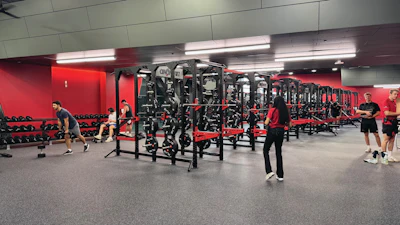

 Photo courtesy of Duke University
 Photo courtesy of Duke University
 Photo courtesy of Duke University
 Photo courtesy of the University of Cincinnati
 Photo courtesy of Duke University
 Photo courtesy of Duke University