In August, the NWSL’s Portland Thorns and WNBA’s Portland Fire cut the ribbon on a joint training and performance center, a first-of-its-kind facility for professional women’s sports that sets a new standard in helping female athletes thrive.
The Kaiser Permanente Performance Center contains spaces for athletic training, sports science, strength and conditioning, and recovery catering to professional athletes representing two sports with common performance needs and objectives. The facility also includes two full-sized soccer pitches, two full-sized basketball courts, a 5,000-square-foot weight room, an outdoor training zone, a dining room and kitchen, family spaces, locker rooms and team meeting spaces.
“I want to see every single women’s professional team have a facility like that,” says Robyn Stewart, segment manager for athletics and performance at Life Fitness /Hammer Strength, who attended the ribbon-cutting. “And it is no longer a pipe dream. It is becoming a reality.”
The performance team at Life Fitness / Hammer Strength was integral to outfitting the Kaiser Permanente Performance Center with strength training equipment. Following years of experience as an athlete and coach, Stewart has pursued one mission lately: ensuring women’s professional sports teams have access to outstanding strength equipment. Her vision is shared by another former athlete/coach and current colleague, Kim Land, director of performance sports at Life Fitness / Hammer Strength. Land likewise believes that introducing women at all levels of play to strength training can change the game.
“It was really important for us to start at the pro level, because women’s pro sports was exploding,” she says, “but also you want to be an expert at the highest level of performance. Then that trickles down to the collegiate market, to the high school market and it bleeds over to the health club market.”
Stewart and Land have a laser focus on the women’s professional sports ranks, but they remain keenly aware of the impact the work they do has on other industries. AB spoke to several strength experts, from product manufacturing representatives to coaches and practitioners at each level, and all see the changing tide that began with the women’s pro sports popularity boom and continues to make waves in the ways even everyday women use strength equipment.
“It used to be more ‘for dudes,’ ” says Stewart, “and now, you can go into spaces and see a shift happening in fitness overall.”
Photo courtesy of Life Fitness / Hammer Strength
Gym-timidation
For a long time, one of the greatest barriers to women’s access of weight rooms was intimidation. Even 10 years ago, Denise Zygarlicke, global marketing manager of strength at Matrix Fitness, remembers walking into health clubs with a stark gender divide.
“The women were on the treadmills and the guys were in the weight room,” she says.
That intimidation runs deep, and it isn’t a simple barrier to overcome. Annie Hinkhouse sees it even in the high school space, where long-held misconceptions about belonging and body image still impact the mindsets of girls. “I can focus on telling the girls they belong here and have every right to be here,” says Hinkhouse, female weight training teacher and head girls’ track and field coach at Reedsburg (Wis.) Area High School. “I want to eliminate weight room intimidation, because we have a large number of students who take this class and are not athletes. For them, weight training is simply a lifestyle.”
“We’re still fighting social norms,” Zygarlicke says. “[Women] want to be in a situation and around people who they are comfortable with, and I think a lot of women who are beginners are not as comfortable as the men.”
These experts say eliminating gym-timidation has more to do with messaging than any specific piece of machinery made for women. Says Land, “We’re not going to make a women’s line of equipment. That is not what this is all about. It’s about picking the right pieces of equipment that are needed for a practitioner who is going to be coaching women.”
In the health club industry, Zygarlicke suggests that “gyms would really benefit from a ‘Lifting 101’ or ‘Beginners’ intro to lifting’ and it would drive female engagement.”
At the high school level, Hinkhouse says fighting the assumption that the weight room is only for the football team remains a key piece of her messaging. “We can be here. We should be here. In fact, we should be here more,” she says. “It’s a shift in mindset.”
And that mindset shift remains present even in the professional teams on the Life Fitness / Hammer Strength client list. Prior to the proliferation of purpose-built facilities, Stewart and Land worked with women’s teams that were relegated to sharing weight rooms at local colleges or sharing facilities made primarily for professional men’s teams.
“They would train at smaller Division II or III facilities. It was kind of in a corner and it would be shared with the general population of the school,” Stewart explains. “Or, they would share with men’s teams and there was a feeling that they were in borrowed space. They were an afterthought.”
A space to call their own has proven to be transformational for not only female athletes’ physical performance, but also their confidence. “I notice a huge difference as we go through the school year and the girls start to understand how much they need strength training,” says Hinkhouse.
Zygarlicke identified a similar shift in older women, adding, “There are more women in the weight room in general, but even more so, there are older women who are getting into weight training for the first time. It’s healing to watch a generation of women realize that strength is something to aspire to and work toward. It’s so encouraging.”
Photo courtesy of Matrix Fitness
Trickle down
The increased presence of women in the weight room at both health clubs and high schools has roots in the professional women’s sports boom.
“They’re like ‘Wow, these guys are the best athletes in the world and they train on this equipment. I want to train on that,’ ” says Land. “It sets a foundation and addresses what women athletes want and need.”
Stewart called her shot several years ago, identifying professional women’s sports as her industry of focus. Since then, Stewart, Land and Life Fitness / Hammer Strength have outfitted several of the country’s top WNBA teams and other professional women’s teams, including those in the recently launched Unrivaled 3v3 women’s basketball league.
“We got connected to Unrivaled, and they had a [weight] room set up for season one. We had a few pieces in there, and at first it was a facility with multiple different vendors,” Stewart says. “Then, year two, they expanded and we had the opportunity to go in and do the entire thing. It is 3,000 square feet of strength and conditioning equipment. We created that space, did the layouts, the planning, and put together something that would benefit the athletes and the coaches.”
Unrivaled allows WNBA players and others to compete in the offseason. It is player-owned, and those who compete are provided with equity in the league. When players had a chance to create their dream league and facilities, they prioritized strength and recovery. And now, performance centers are making the leap from a luxury to a requirement for women’s professional teams.
“Unrivaled is a very unique space in that it is an ecosystem of things. Whether it’s strength and conditioning, recovery, sports science or medical, they do it all there,” Stewart says. “It was a neat situation to learn from them what was important, not just the equipment — though a lot of it is equipment — but also how do they train, when do they train, how do they recover? They all train a little bit differently.”
The women may have unique training modalities among themselves, but when it comes to differences between the genders of professional athletes, Stewart and Land detect very few.
“It has more to do with body type and size, which can also go back to specific sports, not so much a female piece or a male piece,” explains Stewart, noting that a small-framed gymnast will have different training needs than a six-foot-tall WNBA star. “No one has ever asked me to ‘build this for my female athletes,’ but they’ve asked me to build something that will do a particular movement because they need it for a particular sport or return-to-play situation.”
While Stewart and Land focus mainly on the professional basketball space, Zygarlicke knows that other professional sports carry significant influence regarding the weight lifting habits of female gymgoers. She credits iconic female athletes — from Venus and Serena Williams (tennis) to Ilona Maher (rugby) — for breaking barriers in women’s strength training. “[They] have done a phenomenal good to women everywhere, because everybody talks about their shoulders,” Zygarlicke says. “Finally, a woman with a lot of exposure and talent, and she’s a very accomplished athlete. [Maher] has also been transparent about her struggles with self-image and defying societal norms.”
Adds Land, “Anything from their cycles to the pelvic floor and everything in between, more information is starting to get out there, and a little bit of that is a trickle down from the pros.”
Lifting 101
Zygarlicke doesn’t just talk the strength training talk, she walks the walk. This year, she competed in America’s Strongest Master Strongman and placed third, proving her dedication to women’s strength training isn’t simply a line in her marketing pitch, but truly a core life value.
“I’ve seen a shift in general in women’s curiosity about being in the weight room and getting strong,” she says.
From her four-year tenure as a local gym owner, she saw firsthand the increasing presence of women in the weight room. When she started, lower-body exercises using selectorized machines ruled the day, with light dumbbell work in the mix, as well. “What I tried to do as a gym owner and personal trainer was take a look at women’s upper body strength,” she says. “Women are traditionally afraid to train upper body for fear they will get bulky.”
But Zygarlicke is quick to point out that the kinds of weight training most women gravitate toward will not lead to bulky physiques. Instead, she prioritized the strength needed to function easily in daily life. It isn’t about maxing out the weight on the barbell, it’s about becoming capable.
“I would talk to clients about their daily activities — stereotypical activities like holding onto your toddler or lifting a carry-on bag on an airplane,” she says. “People would start thinking about it in that respect and say, ‘Oh, yeah I would like to be able to do all that stuff.’ Then, 35 pounds becomes something to work toward.”
That mindset changed the way women — especially older women — showed up to strength train in her gym. “The majority of people in my strength training classes were women, some of them discovering these movements for the first time,” says Zygarlicke, noting that women also started coming to the gym more regularly when they realized they could do more than spend an hour on the cardio equipment. “Now they get to do other things and they are more engaged. They are more challenged.”
As they experimented more with strength training, Zygarlicke could see a marked change in her older clientele. “I’m encouraged by seeing more women taking ownership of their health, especially as they age,” she says. “There’s research out now that shows that muscle wasting starts to occur in your 30s and 40s if you’re not regularly resistance training.”
Students at Reedsburg Area High School explore the weight room in Annie Hinkhouse’s strength training class.Photo courtesy of Reedsburg Area High SchoolThe next generation
While Zygarlicke focuses on building the strength repertoire of middle-aged and older gymgoers, Hinkhouse is changing the perception of strength training for a younger generation.
She took the job at Reedsburg Area High School nearly 10 years ago, and in that time, has profoundly reshaped the way female students approach the weight room. “When I was in high school, we would have a normal gym class that just went into the weight room as one unit. We didn’t get that every day,” she recalls. “We would lift for two weeks and then never go back in the weight room. So, this strength program has been a really great thing, because now the kids understand what to do, and they notice the difference when strength training isn’t a part of their lives.”
Hinkhouse’s own high school experience is still a common one in many parts of the country. Some student-athletes may have regular access to the weight room, but the average student — and girls in particular — may not spend time in that space.
Land and Stewart also acknowledge the issue.
“It’s not by design. It’s by default that these problems happen at the lower levels,” says Land. “The more we can educate, the better it’s going to be.”
While Reedsburg has overcome several obstacles in bringing the strength class to life, including a weight room renovation in 2021, Hinkhouse admits that even her progressive department has a long way to go. “We really need to keep our foot on the gas because it hasn’t all shifted yet,” she says. “The mentality of ‘we all get the weight room’ is still an uphill battle and shifting the focus for the girls has been my biggest push.”
In Hinkhouse’s strength class, girls learn their way around the weight room. They use an online platform to guide their workouts, which Hinkhouse can preset or edit from her own side of the tool, and she has seen the difference that online tracking has made in the students’ acceptance of the workouts.
“It is a modality that has been super helpful compared to paper logs,” she says. “It keeps track of all their weights and history. They can see, ‘Oh I bench pressed 65 pounds on Sept. 3,’ or, ‘I ran for 4.2 seconds.’ So that is a really cool tool.”
Several students at Reedsburg take Hinkhouse’s class semester after semester, even beyond the basic P.E. requirements. That is another way the online platform has helped enhance their training, because lifting records and workout history from past semesters continue to live on the tracker.
In this way, Reedsburg’s investment in students’ health and wellness serves as a shining example for other schools looking to gain strength and conditioning accreditation for their coaches or even upgrade their facilities. Says Hinkhouse, “Better facilities lead to better culture, but the hard thing is getting the facilities to match what we need.”
Beyond the facilities, Land emphasizes the importance of women like Hinkhouse serving as examples for female student-athletes. That representation and experience can enhance weight training for girls, who may require different modalities than males, and untrained or non-accredited coaches may be ill-equipped to guide female athletes properly.
“A lot of it is they don’t know what they don’t know,” Land says. “Or, the school’s old football coach says, ‘Hey, I’m the strength guy,’ but that is going to hurt the female athletes. So that is a big thing for us, too: advocacy and education, coaches being able to have access to more information on how to train women.”
“It’s okay that we’re different,” says Hinkhouse, an advocate for offering a variety of weights. “The standard barbell is 45 pounds, so I pushed to get some 35- and 15-pound bars that everyone can use. I know there are students who struggle to move a 45-pound bar. I know they’re going to want to use a 15-pound bar, because just to get it from here to here can be a battle. If they walk right in and can’t even move the bar, then they want to quit.”
By and large, Hinkhouse’s students aren’t giving up when they face a new challenge in the weight room. Instead, they are embracing the new training modalities, and the impact is showing up on the court, the field and the track. “We’ve seen an increase in our sports performance,” says the coach. “We’ve had more success in our sports because the strength training programs have been consistent and the student-athletes have been consistent.”
Across all levels of experience, strength and conditioning stands to improve not only female athletes’ athletic performance from the high school to professional ranks, but also the everyday strength of club members and gymgoers. “You can be strong. You can be capable. You can do a world of good for your health,” says Zygarlicke.
In 2026, strength training isn’t a passing trend, or a modality merely on the upswing. Rather, strength training is a proven piece of the overall fitness puzzle for both men and women. And female weight lifters are realizing now more than ever that they belong in a weight room, working every muscle in their bodies, and gaining the confidence to feel like these machines, products and spaces are designed for them, too.
Zygarlicke sees the future of women’s strength training and knows it includes “beautiful shoulders and strong backs, and people realizing that this is sexy,” she says, adding, “Not only is it sexy, it’s also useful. It keeps you healthy for years and years. There has been a really positive shift when it comes to women and strength.”
The shift may have taken time to arrive — tackling gym-timidation and cardio-centric thinking along the way — but these strength experts don’t expect women to leave the weight room any time soon.
“Society is ready for strong women,” Land says. “The world is a better place when women are strong enough to stand on their own and live their own lives, not having to rely on anyone else. A lot of that feeds into the strength and confidence that women of any age get when they start lifting weights.”
Range of Representation
Denise Zygarlicke, global marketing manager of strength at Matrix Fitness, takes pride in one key accomplishment from this past year: the female models posed on the cover of Matrix’s strength brochure.
“It’s great to see Matrix have myself as a woman in strength, but also recognizing the women in our marketing materials,” she says.
For a long time, advertisements and sales graphics for strength equipment featured large, muscular men using the pieces, because that was mirrored in the fitness center and health club environment. But, as women’s interest in strength training continues to grow, the marketplace has taken on a new look, and women are now seeing representations of themselves in advertising more than ever before.
“When we are choosing athletes and models to get on our strength equipment, we want them to look the part,” says Zygarlicke. “We want to showcase women who look like they know how to move weight, who look like they know what they’re doing, and are knowledgeable athletes on our equipment.”
Jenna Coghlan and Bethany Keepman, featured on this year’s strength brochure, represent two of the many body types in women’s strength training, and Zygarlicke notes the importance of that range of representation. “Our marketing materials go a long way toward shifting the norms away from ‘you have to look a certain way’ to simply looking healthy.”
Coghlan is a champion lightweight Strongwoman and physical therapist, and Keepman is a NASM-certified personal trainer, as well as an older athlete and mother, proving that there is no one way to promote — and celebrate — strength training for women.
“It’s cool to work for a company that recognizes that strength looks different on different bodies,” Zygarlicke says. “We’re willing to showcase that through our marketing materials.”





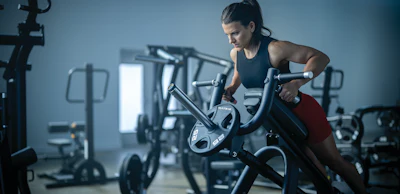

 Photo courtesy of Matrix Fitness
 Students at Reedsburg Area High School explore the weight room in Annie Hinkhouse’s strength training class.Photo courtesy of Reedsburg Area High School
 Students at Reedsburg Area High School explore the weight room in Annie Hinkhouse’s strength training class.Photo courtesy of Reedsburg Area High School