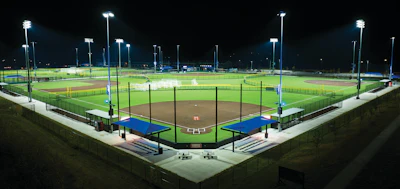
Opened in 2023, Fareway Fields in Norwalk, Iowa, is booked for 36 straight weekends every March 1 to Nov. 1, and sometimes beyond — weather permitting. Its twin 207,000-square-foot synthetic turf “pods” each accommodate four diamonds of varying sizes (thanks to movable fences) in each corner, or two or more soccer fields, depending on the number of participants per side. “This facility is slam-packed full every hour and a half from 8 a.m. to 8 p.m. on Saturday and Sunday,” says Casey Scheidel, who operates the complex as president of field construction and maintenance contractor Iowa Sports Turf, adding that weekend competition typically begins late on Friday.
Fareway Fields is the rare sports tourism destination situated in the heart of a city. It occupies 15.5 acres of prime downtown real estate, surrendered at a discount on the promise it would boost Norwalk’s economy and commercial property values. On that front, Fareway has hit a game-changing home run for this community of 13,000 located 11 miles south of Des Moines.
“This design uses real estate really well,” Scheidel says of Fareway’s unconventional but efficient layout that essentially inverts the traditional diamond cloverleaf. “We did this specifically to build an athletic complex in an urban space. This was going to be Norwalk’s new city center. ‘Let’s build a sports complex right in the center of town, and this is going to bring volumes of people to it and spur all the businesses from it.’ We’re talking restaurants, hotels, coffee shops. Norwalk has never had a hotel in their town. They now have two hotels, right next to the sports complex.”
Truth is, Scheidel could fill three times as many playing surfaces as what Fareway Fields offers, if he weren’t completely landlocked. “Could I use six pods? Absolutely,” he says, adding that just such a sports complex exists in Des Moines — its individual pod design inspired by Fareway. “As we’re up and running it now, the soccer group is expanding and wants more fields. Well, I can’t give them more space because baseball and softball are eating up all the rental time. We built it like this, but quickly these groups have expanded so much that it was too small before it was even finished.”

Pro forma process
Though atypical in its design and location, Fareway Fields is like a lot of sports complexes popping up across the United States in that its operation is a break-even proposition — a fact that only emphasizes the importance of right-sizing such development for maximum revenue generation.
“From a financial standpoint, it can be really hard for a sports complex to break even, so a lot of communities might treat it just like a regular regional park. It might not bring money, but it brings in a great draw for the local businesses, and it just enhances quality of life for the community members,” says Jason Blome, senior partner at Des Moines-based architecture firm RDG Planning & Design. “A lot of times with these large sports complexes, you will see a lot of mixed-use developments popping up right around them, and that’s really what is driving the sports complex boom right now.”
Sports complex design starts with a pro forma — a forecasting tool that estimates capital and operational costs, as well as potential revenue streams and economic impact.
“For the market that we’re looking to design in, what are the components that are in demand there? It might not just be field space. It might be indoor court space, or ice hockey, and there are all sorts of considerations for how to figure out those answers,” Blome says, pointing to stakeholder meetings with various groups in the community or surveys of community members.
Sizing is important not only to meet regular demand, but to handle large destination events.

“Tournament directors want to be able to go to one location — whether it’s indoor, whether it’s outdoor,” says Darin Barr, president of Ballard*King & Associates, which sees sports complex planning as a growing segment of the firm’s recreation pro forma work. “If it’s indoor, we want to be able to go to one location, and we’ve got six, eight, 12, however many basketball courts or volleyball courts. If you’re saying, ‘We can get you 16 volleyball courts, but it’s at four different locations,’ you’re probably going to lose out to a provider that can do 12 courts in one location. They’re really looking for that convenience. Same thing with fields. How many fields can you afford to build?”
To be a true one-stop tournament destination, sports complex stakeholders must determine their desired business-drawing potential and plan accordingly.
“When we talk with people about tournament complexes, we typically start with minimums,” Barr says. “If you want to do a local basketball tournament, you’re going to need to have at least four courts. If you want to do a regional tournament, then you’re probably jumping up to eight. And then if you go national, it goes up from there. In a lot of cases, when we’re talking about sports complexes, it’s two different focuses. What can our community support Monday through Friday? And then what can we leverage to do tournaments on the weekend? We do have those clients that go ahead and say, straight up, ‘I want this to be a tournament complex, and we need to start with a big number, knowing that maybe the community isn’t going to use all those spaces Monday through Friday, but we’re willing to accept that for whatever kind of economic impact we project is going to come from it.’ ”
Minimums are driven by the maximum usage each feature of the sports complex can handle, according to Ballard*King senior associate Scott Caron. While serving as parks and recreation director in Longview (population 85,000), Texas, Caron oversaw an outdoor complex containing 10 softball diamonds with 200-foot fences, six baseball fields with fences ranging from 250 to 300 feet, a Miracle Field for individuals with disabilities, and 15 soccer fields of various sizes, including four of full international size — 120 by 80 yards.
“There’s a maximum number of teams you can fit on a field per day,” Caron says. “There’s a lot that goes into it, whether it’s a three-game guarantee, a four-game guarantee. Is it over three days? Is it two days? Is it a single day? You plan on eight to 10 teams per field, so if you have a fourplex, you’re at 32 teams. Most of the time, in order to host regional tournaments that are drawing within a three-hour drive, those tournament sizes are going to be fewer than 80 teams. So, you can get those in on eight diamonds. To host a true national tournament, you’re going to need substantially more than that. It depends on where you want to be in the marketplace, as far as the number of tournaments or number of fields within your complex.”
According to Caron, complex operators can expect softball games to take roughly 90 minutes, and baseball games two hours. “Some complexes allow play until 10, 11, midnight,” he says. “The more games that go on, the more teams you can get in.”
A typical start-to-finish timeline for a sports complex development might be two years or more from pro forma through construction, according to Caron, who was involved in two phases of the five-phase development process in Longview. “I was involved in the Miracle Field construction, as well as two additional softball fields, two additional baseball fields, and then we converted two of the full-size natural turf fields to artificial turf.”
Demand dictated such expansion. For example, there wasn’t a Miracle Field within a two-and-a-half-hour drive.
“The initial one was girls’ fast-pitch softball,” Caron says. “There wasn’t a complex for that in Longview, and so that was the impetus behind starting it all. But it was truly a vision, a master plan process that was started with all fields and youth sports activity, and so it just progressed from there, primarily based on demand.
“Our hope was to bring in additional tournaments and to have one site able to host all of those things, as opposed to driving across town. We wanted to have a venue where tournament directors could come and feel comfortable with the number of spaces and opportunities that they had, but then also for local parents who had children in multiple age groups, that they would be able to have one destination, as opposed to mom going to one place, dad going to another, maybe grandma and grandpa going somewhere else.”
 Photo courtesy of Fareway Fields
On-site amenities
Numbers and configurations may vary, but sports complexes share some common considerations when it comes to on-site amenities.
“What is there to do at that field or at that location while big brother is playing a game? Is there a playground? Is there a spray pad? Is there a walking trail? What kind of concessions do you have?” asks Barr. “And then you go one step further, and what’s surrounding the facility? How close are hotels? Can we walk to it? From a coach’s perspective, ‘I have to get all these kids on a bus, and we’re going to drive eight hours. How many times do we get back in and out of the bus? Is the hotel right next to a Walmart, where we can get snacks, and if we walk 15 minutes, we can be at a place to eat? All of those things start to play into the decision in terms of where you’re going to go.”
Onsite parking, concessions and restrooms are a must. A rule of thumb in spectator sports is one parking stall per three or four seats within a venue, but such formulas become a bit sketchy, Blome says, given that sports complexes often don’t emphasize fixed seating. “You’ll see a limited amount, maybe 50 to 100 seats on some metal bleachers — maybe mobile bleacher units — but for the most part, given the culture of travel baseball, softball and soccer, particularly, parents are bringing their own comfortable chairs,” says Blome, who coaches his son’s travel baseball team, and whose daughter has played up to 75 games in a single softball season. “Facilities really don’t build in those fixed seats for these outdoor sports complexes like they once did.”
Concessions facilities are similarly vague, running the gamut of warming capacity for pre-prepared food items to full commercial-grade grilling and refrigeration capabilities. Some sports complexes make space for food trucks to supplement feeding operations. “One example is like an Amazon Go, where you enter the facility, you put your credit card through, you pick up what you want, and you leave without having to check out,” Blome says. “That’s becoming more popular. You see them more in professional stadiums, but you see those in some sports complexes. Another trend is offering beer and liquor at complexes now. Again, it’s really trying to attract and retain spectators to be at the facility all day.”
International Building Code dictates that toilet fixtures on the site of outdoor sporting events and activities should number one per 75 males for the first 1,500 in attendance and one per 20 beyond that. For women, it’s one per 40 for the first 1,520, and one per 60 from there. “I’m not an architect or engineer, but I like to say a bathroom should be located within 500 feet of a playing surface,” Caron adds. “Any more and we are concerned about the safety and security of our children, as we all should be.”
How then does one estimate how many people will be on the premises? “If it’s a local tournament, every one participant brings two to three spectators,” Barr says. “If people are traveling seven or eight hours to get there, it might be fewer than that. It might only be one spectator per athlete.”
 Photo of Prairie Ridge Sports Complex, Ankeny, Iowa, courtesy of RDG Planning & Design
Synthetic turf popularity
Perhaps nothing factors into whether a team travels great distances to visit a sports complex more than its confidence that it’s going to actually compete once it arrives there. In that sense, synthetic turf has become a major drawing card.
“My youth team that I help coach is looking at where we’re going to be playing all of this year,” Blome says. “From what we’ve seen, the facilities that have synthetic turf for their fields are the facilities that fill up first, because if you know you’re traveling for that weekend, you want to be pretty much guaranteed that you’re going to play.”
Adds Barr, “If you’re talking about it from the tournament perspective, they want to know what the field is, and nine times out of 10 they’re looking for that synthetic.”
Playability not only impacts visiting teams, but sports complex operations — perhaps extending availability and revenue potential into the so-called shoulder seasons, particularly in the Midwest and northern states, according to Barr.
Scheidel reports that the only time it makes financial sense for full-size baseball to dominate one of his pods (with its 350-foot fence leaving room beyond center field for only one concurrent softball game’s 200-foot fence) is when accommodating out-of-state collegiate teams in the early spring. “We balance how we schedule it, because there’s a financial impact,” he says. “Instead of running four fields at one time, you may be only running two fields at a time. Well, that’s half the amount of people who are going to your concessions stands, and that’s essentially half the amount of rental fees you’re able to charge.”
Unplayable fields, meanwhile, are a sports complex’s scheduling nightmare.
“Youth soccer, in general, is played on Saturdays, and if you get a torrential rain, a downpour, on a Friday or on a Saturday, that pushes the season back,” Caron says. “Of course, if you have tournaments scheduled in there, they have to play on those particular dates. That’s the nice thing about high-quality turf. Natural turf can often recover and do very well. However, it still can’t act the same and do what artificial turf does in being able to handle water. The other challenge is, if you do tear up a grass field, it’s not like the professionals, where you can just cut out the sod and put new sod down and in a few days you’re good to go. You’re waiting an entire season before you can do something about it.”
For that reason, Scheidel shares that his field installation enterprise has moved predominantly toward synthetic turf. “From July to the end of last year, we built seven synthetic fields and one natural field,” he says. “That needle has been moving constantly in the last five years, and it’s getting to the point now where everything we do moving forward is going to be synthetic.”
The proliferation of sports complexes shows no sign of slowing.
“I refer to it as the modern-day arms race,” Barr says. “If you’re in a metro area and you build a building and it’s got six indoor basketball courts, and you start having success with it, then somebody adjacent to you is going to build one with eight, and then somebody is going to come out of the woodwork and say, ‘Well, if they can make eight successful, I bet I can do 16.’ To corner the market, you need to continue to invest to be able to maintain your foothold, because there’s the possibility somebody’s going to come along and imitate what you’re doing.”
Ideally, a sports complex should plan for expansion, even if it means acquiring acreage that sits dormant for years. Says Burr, “It’s more cost-effective to do all of the land moving and the leveling and grading on the front end.”
And going big on field dimensions already in use facilitates programming options, according to Caron. “Everybody loves to play on the appropriate size field, whether that’s a diamond or a soccer field, or a type of court or space used for a sport in that age group,” he says. “But you can always make a large space smaller, but you can’t make a small space larger. If you have the ability to have a larger space where now you can draw lines on it to make it smaller, it’s not the best sometimes, but it allows for greater flexibility for your fields.”
Such granular variables are no insignificant part of the bigger planning picture. “Every community is a little bit different in their approach to these, and they really need to understand their local market, and then also where they want to be in the context of doing tournaments. From the beginning, it’s really about determining what their priorities are,” Caron says. “Communities have these conversations about youth sports and sports tourism, and how do you go about that balance of local use versus tournament use? Communities have to make those value judgments.”
“What’s your stated goal for the facility, and how many different groups are you trying to support?” Barr asks. “Is it possible to have a community facility that is also a tournament sports complex? Absolutely. Is it possible to have a sports complex that’s focused on that but also supports some community use? Absolutely. But knowing that on the front end helps significantly with the planning process.
The power of light
 Photo of Fareway Fields, Norwalk, Iowa, courtesy of Musco Sports Lighting
Not only does Fareway Fields host multiple sports activities in the heart of Norwalk, Iowa, it also serves as a working laboratory of sorts for the sports complex’s owner 64 miles to the east in Oskaloosa: Musco Sports Lighting.
From entertainment packages, to BallTracker Technology® to accent lighting on poles, Fareway Fields puts all of Musco’s latest innovations on display. It starts with delivering light to the center of synthetic turf playing surfaces measuring 207,000 square feet, a task accomplished using 70-foot poles. “These pods are so big that it does require a large pole with a lot of fixtures on it to be able to get light to that location,” says Casey Scheidel, who runs Fareway Fields as a Musco employee.
That said, controlling light is just as important as throwing it. Says Scheidel, “Especially when you’re doing a complex like this in the middle of a residential area, city code says you have to have light levels of zero at the property line, so the spill and glare part of lighting, which is kind of really what makes Musco stand out, that’s really important in something like this, that we can have those light levels down to zero immediately after the sidewalk.”
Each light pole at Fareway has one fixture pointing skyward — just enough to illuminate the bottom of a ball as it leaves the greater lighted area, but not so much as to pollute the night sky. “We want to make sure our light is focused exactly onto the playing surface,” Scheidel says. “However, in the case where you lose a ball, you have to put some light on it, so we put as little as possible so we can make sure we still see it without just having this incredible amount of light pollution.”
The same effects displayed after big league home runs are possible with Fareway’s light fixtures, but Musco offers ways to dazzle even when field lights are off and the sports complex is dormant. At Christmastime, for example, the light poles are colored red and green with accent lighting. “Norwalk High School uses a purple color,” Scheidel says. “If it’s Friday night, we will light up the poles in purple. Yes, the lights are off, but we have the poles lit up to whatever event may be going on. It allows us to do some of those community engagement kinds of things that are cool.”