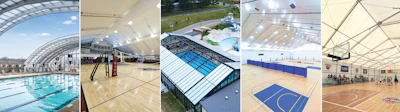
When facility operators weigh options for covering a pool, expanding an athletics footprint, or adding year-round programming space, the conversation has evolved well beyond cost-per-square-foot. Today’s retractable, tensioned-membrane and alternative-structure systems are competing directly with conventional construction on performance and permanence — and arguably winning on speed. It’s not only possible but now expected that a structure erected in weeks will last for decades. AB executive editor Andy Berg asked sales and business development leaders from five leading building-systems manufacturers the same five questions. Their answers reveal an industry eager to shed its “temporary solution” reputation for good.
Cihan Ozdemir
Vice President of Sales | DynaDome Retractable Structures
What recent advances in materials or construction methods are having the biggest impact on how these structures perform? The more projects we install, the more experience we gain in understanding best practices and ways to improve. The field installation crews bring back many lessons learned, which is allowing us to constantly reevaluate how we approach the assembly and what can be done ahead of time to minimize that downtime for the client. By adapting our construction installation methods and techniques, we can get assembly completed in three weeks — what was once five weeks with the same manpower. We can do this with a combination of shifting assembly off-site on much of the work, redesigning several of our parts and mating pieces to make the assembly of those frames and finished areas quicker, and reduce the amount of time on the roof to mitigate our risk to mother nature keeping us off of the roof.
How have design expectations changed over the past five years — are clients asking for things today they weren’t asking for before? As we continue to expand our customers and industries to include more indoor-driven spaces, the need for fully thermally broken systems has been part of the drive for improvements in so many areas. We have been hard at work improving energy performance and seeking efficient glazing materials to insulate spaces better, thereby reducing costs associated with utilities in heating and ventilation.
How do lead times and installation complexity factor into project planning, and what surprises clients most often? The lead times for our manufacturing and installation are always met with surprise. Installation time for a DynaDome structure that measures about 100 feet in width by 100 feet in length over a typical eight-lane, 25-yard pool, and can be extended or retracted at the push of a button, is about three weeks from start to finish. I think that speaks volumes of the engineering and design of the overall product and the team that we have built.
When a client is comparing options, what questions should they be asking that they typically aren’t? What equipment do I need? How long will we be down? Can I use the space year-round? How long does it take to go from indoors to outdoors or vice-versa? How easy is it operate? What is the expected maintenance for the system or the equipment inside?
What’s the most common misconception buyers have about what these structures can or can’t do? The utility costs are much less than your typical indoor pool spaces. The ability to plan programming without worrying about cancelations or weather-related concerns is a major relief for many aquatics directors or camp directors. Confidence in access allows for freedom in programming. UV protection allows for the users to be protected at all times. When the sun is shining, the light is coming and the space is being heated freely, but no UV is damaging the skin of the spectators, life guards, swimmers or anyone else inside.
Jim Avery
Vice President | Sprung Structures
What recent advances in materials or construction methods are having the biggest impact on how these structures perform? With regard to advances in tensioned-membrane structures, PVDF coatings and Tedlar film have extended the life of the exterior membrane to 30-plus years. This is significant, as Sprung structures are engineered and designed as a lifetime building solution. At the end of a membrane’s lifecycle, it can be replaced much like a roof on a conventional building.
How have design expectations changed over the past five years — are clients asking for things today they weren’t asking for before? Conventional construction expenses and timelines have increased sharply in recent years, and now, more than ever, clients are focused on speed and cost when it comes to deciding which building solution to select.
How do lead times and installation complexity factor into project planning, and what surprises clients most often? With conventional building methods, clients often face lengthy design phases, multiple contractors, and extended construction timelines, all of which can lead to delays and unexpected costs. What surprises many clients is how quickly those factors add up. In response, they may try to scale back their plans, compromising on what they originally set out to build. That’s where Sprung offers a different approach. By streamlining design and reducing construction complexity, Sprung structures can be delivered much faster, often in a fraction of the time and at a much lower cost than traditional builds.
When a client is comparing options, what questions should they be asking that they typically aren’t? The most important question is, “Where can I go and see an example of the product?” Tensioned-membrane structures come in all shapes and sizes, and it’s critical for prospective clients to tour a finished, permanent solution and talk to the people using the structure. Clients can also visit the manufacturer’s production facility to see the quality of the product firsthand. With Sprung, seeing is believing.
What’s the most common misconception buyers have about what these structures can or can’t do? A common misconception is that a Sprung structure is short term. However, when clients take the time to learn about the technology, they are surprised and relieved to find out that a Sprung structure is, in fact, a durable and thoroughly proven building solution that will meet their budgets and construction timelines, often exceeding expectations. Sprung has supplied over 12,000 structures in 100 countries. The structures also have to meet applicable local building codes, which can vary by location, use and occupancy requirements. Sprung structures are also available in a wide range of exterior color options. Thanks to advances in technology, the architectural membranes offer long-lasting, colorfast finishes that maintain their appearance over time.
Nancy Patterson
Director of Design and Business Development | OpenAire
What recent advances in materials or construction methods are having the biggest impact on how these structures perform? OpenAire is an aluminum manufacturer. This is a non-traditional material for large-span super structures. The assumption from most consumers is that “big metal buildings must be steel.” We have proved this is not the case. OpenAire has been building with painted aluminum for over 37 years. The benefits, especially in an aquatics venue, are immense. An OpenAire structure is constructed of a thermally broken, all-aluminum frame with stainless steel hardware. Aluminum by its nature does not rust or corrode. Additionally, the frame is painted with a baked-on finish that never has to be repainted. A steel frame may need to be repainted every five years and must be constantly inspected to make sure all nicks and scratches are touched up. Any scrape in the painted steel finish will be a starting point for rust. The highly corrosive nature of a natatorium — or worse, an indoor waterpark — due to the heavy chemically laden air means that wood structures rot and steel structures corrode. Aluminum does neither.
How have design expectations changed over the past five years — are clients asking for things today they weren’t asking for before? Building sustainably is no longer an optional or nice-to-have extra. It’s an expectation not just from customers but by global building codes. It’s also a requirement of stakeholders who mandate smarter long-term investment strategies. Whether you are renovating or growing a facility, or starting from scratch, the expectation is that whatever you add or change is done in a way that uses less energy, lasts longer and meets all building codes. OpenAire buildings do all of that and then some. We are thermally broken, permanent structures that meet energy code requirements and use less energy to operate. Opening a roof and the walls of a building means essentially turning a building off for weeks or months of the year. This naturally means saving energy by using less power for lighting and less gas for mechanical ventilation systems.
How do lead times and installation complexity factor into project planning, and what surprises clients most often? Most people understand that sometimes external forces cause internal delays — like impacts to global shipping routes might delay a delivery, or a festival close to a site may cause an installation pause of over a week because the site cannot be accessed. These issues are sitewide, not just one team, and typically beyond the control of any party. Reasonable expectations when external factors are impacting a project can be handled with open lines of communication. What sometimes surprises clients, however, can be the trickle-down effect of late changes, additions or subtractions, which pause or delay others. When working with a prefabricated structure, we aim to iron out all changes before arriving on-site. For example, when building in aluminum we ensure all parts of the structure are pre-drilled and not drilled on-site — meaning a late addition or change may require the fabrication of new components. While not an issue, this can impact timing depending on the size or complexity of the project.
When a client is comparing options, what questions should they be asking that they typically aren’t? A couple of questions come to mind. Is the building warrantied and for how long? OpenAire warranties all our projects for a minimum of five years. We do this because we can. If a building cannot be warrantied for that long, one should wonder, why not?We know that our buildings are long-lasting and reliable, so we are happy to offer long-term warranties. We know this gives our clients peace of mind, and it allows us to stand behind our claim that this is a lower-cost building to operate. A long-term warranty means we are around for the long haul. We are there to fix or service anything that’s needed — which is virtually nothing for most clients for that entire period and onto the lifetime of the building. Our best references come from our long-term clients from whom we get repeat business.
What’s the most common misconception buyers have about what these structures can or can’t do? OpenAire buildings are no different than regular bricks and mortar. They require foundations, fire suppression systems, dehumidification, lighting and emergency egresses. They are built for the long term. You will not need to replace the roof in eight years. These are not temporary and/or seasonal. They are custom engineered for each site, so they can handle the snow, rain and wind. They meet the building code, save energy and are less costly to operate than a traditional bricks-and-mortar structure.
Shannon Humbert
Sports Business Development Manager | Legacy Building Solutions
What recent advances in materials or construction methods are having the biggest impact on how these structures perform? The biggest advancements are centered around high-performance PVC cladding systems and tighter, more-precise building envelopes. Today’s PVC cladding is engineered for long-term durability, with superior resistance to UV exposure, moisture and environmental wear, which results in longer service life and more-consistent performance over time. Equally important is how these systems are installed. Advanced welding technology creates continuous, high-strength seams that significantly reduce air leakage and eliminate traditional failure points. This directly improves energy efficiency and climate control, especially in conditioned environments. On the structural side, clear-span engineering and prefabrication continue to evolve, allowing for larger, column-free interiors and faster installation. When combined with a tightly sealed building envelope, these advancements deliver lower operational costs, improved interior conditions and reduced maintenance requirements.
How have design expectations changed over the past five years — are clients asking for things today they weren’t asking for before? Design expectations have shifted significantly from basic functionality to performance-driven, high-quality environments. Today, clients expect bright white interior liners that enhance visibility and reduce the amount of artificial lighting required. They also expect tighter, more-energy-efficient building envelopes that support lower heating and cooling costs. Fully customized exterior cladding solutions that align with brand standards and site aesthetics are also expected, and year-round usability, especially for athletics, municipal and operational facilities is important. There’s also a clear shift toward viewing these as permanent, high-performance structures rather than temporary solutions. Clients want buildings that deliver both operational efficiency and a professional, finished appearance.
How do lead times and installation complexity factor into project planning, and what surprises clients most often? Lead times and installation are major advantages. Because of prefabricated components and streamlined construction processes, these buildings can be installed significantly faster than conventional structures — often in a matter of weeks. Our clients are surprised at how quickly the structure goes up once site prep is complete, as well as how efficient and organized the installation process is. They’re also impressed by how minimal the overall construction disruption can be. Where projects can get delayed is typically outside the building itself — site work, permitting and coordination with other trades tend to be the critical path items. Once those are in place, installation is usually much faster than expected.
When a client is comparing options, what questions should they be asking that they typically aren’t? Many clients focus heavily on upfront cost, but the more-important questions are about long-term performance and efficiency. How tight is the building envelope, and how does it impact heating and cooling costs? What are the long-term maintenance requirements of the cladding system? How are the seams constructed, and what does that mean for durability and air infiltration? What is the expected lifespan of the PVC cladding and structural system? How will this building perform in real-world environmental conditions over time? These questions help shift the conversation from initial price to total cost of ownership and operational performance.
What’s the most common misconception buyers have about what these structures can or can’t do? The most common misconception is that these structures are temporary or lower-performing than traditional construction. In reality, modern buildings with engineered PVC cladding are designed for long-term, year-round use. They can be insulated, lined and tightly sealed to create controlled interior environments that support everything from athletics to industrial operations. Another misconception is around interior quality. Clients are often surprised by how bright, clean and finished the interior environment feels, especially with white liners that improve visibility while reducing the need for excessive lighting. Ultimately, these structures deliver increased durability, energy efficiency and lower maintenance costs, making them a highly competitive alternative to conventional building methods.
Steve Lipking
Special Events Product Specialist | Anchor Industries
What recent advances in materials or construction methods are having the biggest impact on how these structures perform? One of the biggest shifts is how quickly high-performance structures can now be delivered without sacrificing durability. Compared to traditional construction timelines, which can span months or even years, today’s engineered structures can be deployed in a matter of weeks. That speed has become a performance advantage in itself.Advancements in materials, including stronger membrane fabrics and hybrid aluminum/steel frames, mean these structures are built to handle higher wind and snow loads while maintaining a lighter footprint. We’re also seeing improved insulated panel options that enhance energy efficiency and allow these buildings to function comfortably year-round.The combination of rapid deployment and long-term performance is what’s really redefining expectations. Clients no longer have to choose between speed and strength.
How have design expectations changed over the past five years — are clients asking for things today they weren’t asking for before? Definitely. One of the biggest changes is the shift toward more-stringent building codes and higher performance expectations. Clients today aren’t just looking for coverage, they’re expecting stronger, fully engineered structures that meet local codes and perform like permanent buildings. In the athletics space especially, that means better environmental control, improved durability and structures that can support year-round use. There’s also more emphasis on long-term-value facilities. Customers want solutions that aren’t just quick, but also reliable and compliant. What used to be considered a temporary solution is now expected to deliver the strength, safety and usability of a traditional brick-and-mortar building.
How do lead times and installation complexity factor into project planning, and what surprises clients most often? Lead time is one of the biggest advantages of these structures. Because they’re manufactured off-site and delivered ready for installation, timelines are significantly shorter than traditional construction. That allows facilities to respond quickly to immediate needs, whether it’s seasonal demand, renovations or unexpected capacity challenges. Installation itself is also much faster and more streamlined than most clients expect. Once the site is prepared, structures can often be installed in days or weeks, not months.
What tends to surprise clients most is just how efficient the process is from manufacturing to install, and how quickly they can go from concept to fully operational space.
When a client is comparing options, what questions should they be asking that they typically aren’t? A key question that often gets overlooked is: How quickly can this solution be delivered and operational compared to traditional construction? Speed has real impact, especially for athletics programs that can’t afford downtime. Clients should also be asking about code compliance and engineering. Is this structure designed to meet local requirements and long-term use expectations? Another important consideration is flexibility. Can this structure be relocated, expanded or repurposed as needs change? That adaptability is a major advantage, but it’s not always top of mind during the evaluation process. Ultimately, it’s about looking beyond the initial build and understanding how the structure performs over time.
What’s the most common misconception buyers have about what these structures can or can’t do? The most common reaction is, “We didn’t realize a relocatable, modular structure could meet permanent building codes.” There’s still a perception that these solutions are temporary or limited in capability, but today’s engineered structures are designed to meet stringent local codes and support long-term, year-round use. What surprises buyers most is that they’re not choosing between flexibility and performance — they’re getting both. These structures deliver the adaptability of a relocatable solution, along with the strength, safety and reliability typically associated with traditional brick-and-mortar construction.