It is August and I am back at Virginia Tech, but this time I am not a student. I am here to drop off my daughter for her freshman year. It has been 30 years since I was a freshman at Tech, and I expected to notice new buildings. What surprised me was realizing how much of the campus transformation had been set in motion by investments in athletics. Virginia Tech isn’t unique. Across higher education, athletic facilities have evolved beyond venues for competition to become catalysts for campus growth.
Athletic Buildings Have Outgrown Athletics
Today's athletic facilities are no longer isolated from the broader life of campus. Rather than just being locker rooms, practice fields, and arenas, they are now the connective tissue of the modern campus. Leading universities are building mixed use environments that blend athletics, academics, community engagement, and revenue generation into a single physical ecosystem. The most successful athletic facilities are becoming some of the most heavily used buildings on campus because they support far more than athletics.
Notre Dame's Campus Crossroads project is among the most-studied examples, transforming the historic football stadium into a daily hub by integrating classrooms, labs, a fitness center, student gathering space, and hospitality venues into the surrounding complex.
Designing for Utilization, Not Just Competition
When building new athletic facilities or renovating existing ones, the goal extends beyond creating a venue for competition. The conversation shifts from scheduling games to programming buildings. Designers should begin with a simple question: What happens in this building on a Tuesday in February? If the answer is “not much,” an opportunity has been missed.
Designing for year-round use changes nearly every design decision. Flexible gathering spaces, adaptable hospitality areas, technology infrastructure, intuitive circulation, and welcoming public entrances become just as important as locker rooms and seating, because the building must serve multiple audiences with very different needs.
We are seeing this shift play out. Northwestern University’s new Ryan Field was conceived not simply as a home for football, but as a year-round asset for the university and surrounding community. The stadium and its surrounding plazas are designed to accommodate student activities, youth sports, festivals, community events, and other programming beyond gameday.
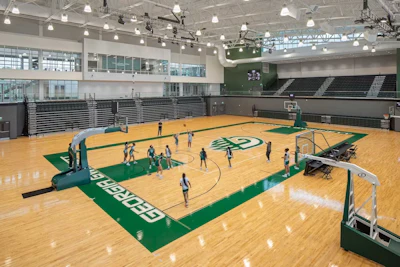
For designers, the challenge is translating that larger ambition into the everyday experience of a building. At Georgia Gwinnett College, flexibility shaped Little’s approach to the Convocation Center and athletic facility from the start. On gameday, the arena can be filled with fans. Retract the bleachers and the same space can accommodate a gala event, a concert, graduation, or other campus events. Designing for these different modes of use allows the facility to remain active well beyond competition and serve a broader role in campus life. Success is no longer measured by the game-day experience alone, but by how well a facility performs on “dark days.”

Designing for Participation and Belonging
Utilization is only part of the equation. A successful athletic facility can also invite students who may never compete on the court or field to become part of the experience.
Beyond flexibility, we thought intentionally about the relationship between passive and active engagement at Georgia Gwinnett College. A student might enter the building and hear activity in the fitness areas or witness a basketball practice. That passive exposure often becomes an invitation to participate, whether that means returning to cheer on the team during gameday or stepping into the fitness center. These design choices create moments of connection, make athletics more visible, and invite the broader campus community to participate.
That same principle can play out on a much larger scale. Penn State’s Bryce Jordan Center illustrates how an athletic venue can become a platform for something much bigger than sports. In addition to hosting basketball, the arena is home to THON Weekend, the culmination of the world’s largest student-run philanthropy. The event brings together thousands of students, alumni, and supporters, demonstrating how a facility designed for athletics can also provide a stage for traditions and shared experiences that help define campus life.

Facilities Can Shape Communities
The same ability to create connection within a campus can extend beyond its boundaries. Athletic facilities can provide a natural bridge between a university and its surrounding community, creating opportunities for civic partnerships, expanded audiences, and lasting goodwill. Soccer programs working with local youth clubs, basketball teams volunteering in schools, and pedestrian corridors planned to connect a campus to a downtown district are all physical and relational expressions of athletics as civic infrastructure.
Entire campus master plans are now being conceived around athletic anchor facilities. Universities are increasingly looking beyond the athletic venue itself to the land surrounding it, exploring sports and entertainment districts that combine athletics with hospitality, dining, retail, events, and other uses that generate activity throughout the year. The University of Tennessee, the University of Kentucky, and Iowa State are among those actively exploring or implementing this model. The facility is the anchor. The sport is the draw. The surrounding development is where the financial return materializes.
While NIL, revenue sharing, and other financial pressures are changing where the returns from athletic investments may ultimately flow, the case for creating facilities that generate year-round value has only grown stronger.
The next generation of athletic facilities won’t be defined by their size or the number of games they host. The institutions seeing the greatest return are creating facilities that bring value every day by connecting students, faculty, alumni, and the surrounding community. That’s the opportunity facing designers and university leaders alike. When athletic facilities are planned as institutional assets instead of standalone venues, they can become the catalyst for how a campus grows, connects, and thrives.