Technology can be at once desirable and intimidating, not to mention expensive. The cost of a given technology invariably comes down over time, but what about the would-be adopter who wants to experience the benefits now, regardless of whether budget dollars exist to cover full upfront buy-in?
To appeal to such interested parties, a handful of companies are making their products available on a subscription basis, as an alternative to outright purchase, and finding it’s an effective way to remove market-entry barriers for the end user while broadening their own market reach.
“That really is the key factor — to be able to operate at a lower price to make sure that you can go in and get more of the market,” says Simon Rytter Christensen, chief marketing officer at Turf Tank, which began offering subscriptions for use of its autonomous field-marking machines in 2019. “But you also have to deliver on what you promise.”
Another autonomous line-striping supplier in the marketplace followed suit. TinyMobileRobots piloted its PAYS model (it stands for Pay As You Spray) at the end of last year, and “instantly we’re connecting with people that we haven’t been able to before,” says Matt Thavenius, the company’s regional sales director for the eastern United States and Canada. “We’d go to a trade show, or we might encounter a customer online, and sometimes they’re like, ‘Hey, has the price gone down yet? Is there anything more flexible to start with?’ The PAYS program does that. It’s no commitment. It’s $1,995 down to get you set up and under two hours to get you trained on the robot.”
NGU Sports Lighting officially launched last September as a way to put LED technology in locations that might not otherwise have the means to install and experience it — such as municipal parks departments and other entities occupying the base of what company president and founder Mike Lorenz calls a sports lighting marketplace pyramid. NGU’s Performance Lighting Delivered program focuses less on the promise of state-of-the-art hardware installation — which, of course, is a key component — and more on the product of light itself.
Photo courtesy of NGU Sports LightingUnlike other products, all sports lighting noticeably degrades over time. NGU offers 10-year service contracts that guarantee predetermined light levels on any given field throughout the duration of the agreement. If measured foot candles fall below that expectation at any point, the client doesn’t pay its monthly installment until NGU rectifies the deficiency.
“What makes our solution a bit interesting is that we deliver to the customer what they really need out of sports lighting,” Lorenz says, pointing to three things in particular. “They need the light level specifically for the venue that they’re lighting, and they need to know that they have those foot candles. They need to know the system’s efficient, and that it’s going to provide an energy savings and a maintenance savings for them. And they need to know how they can control it and operate it. We provide those services to the customer for a long period of time, deploying whatever solution is required to deliver those services, and the customer pays the service fee.
“And what’s interesting from my standpoint as a businessperson, no other [lighting] manufacturer or third party has been willing to take that risk. They market, they hype, they sell, and at the end of the day, they want you to write that check. We’ve backed it up with our commitment. We’re the experts. We understand it. You just simply need light, so let us take the market risk associated with whatever is required to deliver you that service, and we’ll shift the ownership and technology and performance risk from you to the vendor. And if we fail to perform in any given month, you just simply don’t pay us.”
Photo courtesy of Turf Tank
Customer satisfaction critical
Of all three companies, Turf Tank has been offering subscriptions the longest, and Christensen estimates that the percentage of subscribers who choose to renew their agreements is similar to the astounding 95% of U.S. clients who opt for subscription over outright purchase in the first place. “It just makes more sense on every level,” he says.
According to Christensen, the subscription model’s popularity is driven by the transparency of knowing what you’re getting at the starting price point and the flexibility of one- to three-year commitments. It also provides the option to expand robot capabilities in terms of upgrading from the Turf Tank One or “One Plus” to the Turf Tank Two models, or adding field templates and logo designs to software packages, with additional investment.
“It’s technology. It’s rapidly moving forward, so why would you own it?” Christensen asks. “You can own that piece of equipment, but let’s say five years down the line we might have a Turf Tank Three. Why be tied down with equipment that might be outdated, at least in terms of where the standards are at that time? Instead, ship it back to us and get a new one — with a price difference.”
Christensen speaks of Turf Tank’s commitment to the product at hand as a requirement of the subscription model, which “keeps us on our toes in terms of delivering outstanding service,” he says. “We use the saying internally, ‘We win our customers every day,’ because if someone is unhappy with the product, they’ll just ship it back. We have to deliver the quality that we promise people.”
Offering subscription services makes long-term customer satisfaction all the more critical. “It’s a costly affair, because it means we don’t get the same amount of money [up front] that it costs to produce the product,” Christensen says. “That’s why we also have some interest in having people for a longer time. Of course, we’re also big believers in our own product. We have to be.But we actually don’t know the lifespan of the product yet, because the first commercially sold robot is still out and running — and that’s11 years.”
Photo courtesy of TinyMobileRobots
TinyMobileRobots gets even more granular with its 12-month agreements — charging customers only for the time its striping machines are actually in use — the Pay As You Spray approach — albeit with a minimum charge of $350, even if the robot remains dormant for an entire month. “Let’s say you have one football field, and you paint it once a week for a month. That comes to about $700. You would pay us $700 because that’s how much you’ve painted,” Thavenius explains. “Then there are some months that you’re off, and then you spend just the $350.”
The robot keeps track of usage, as does a mobile interface called TinyManager. “It will show you all the jobs that your robot has done,” Thavenius says. “You’ll see what was painted last Thursday. You’ll see that your football field got half painted on Friday because there was a tornado, and then you’ll know from the manager perspective, ‘Okay, let’s get that football field painted first thing Saturday morning.’ And it will also tell you the spray time hours.”
PAYS has represented a tipping point for dozens of new TMR clients, he adds. “For customers that have been on the fence and trying to get a robot for a long time, a lot of them jumped at this opportunity because it’s low entry, and all they really needed is to show their school that this robot is what it says it is” — an extraordinary time-and-labor saver.
TMR has a dedicated rental fleet, but clients can apply the monthly fees accrued during their agreement toward the outright purchase of a robot up to 25% of the purchase price. Time will tell whether any choose to take advantage.
“It’s still new. We’re in the first year of this model,” Thavenius says, adding that new top-of-the-line robots can approach $40,000 in price. “Once we start expanding and learning what our customers need, what they’re able to achieve with their budget team, we’re going to try to adjust to it. It’s not just a new industry. It’s a new market and so often a new line item. When they start to see it, and it proves how important it is to their facility, we try to find a way to make it work, because going into most school demonstrations, the customer says, ‘I love it.’ And then the person behind the door that we don’t meet says, ‘Yeah, well, where’s the money going to come from?’ ”
According to Lorenz, would-be clients mulling the LED sports lighting leap may undergo an even more complicated thought process. “In many cases, it’s less that they lack the capital. It’s the politics around deploying capital,” he says. “You have a budget for a school district, and you need x million dollars of capital to build out classrooms or whatever it happens to be, and you need $3 million for sports lighting. It just is less popular, even though I can build a business case that it’s the right investment to make. We offer an alternative, which I think ends up helping school districts and others adopt the technology for all their venues at one time, rather than having to do them over a period of years.”
Lorenz emphasizes that adoption comes with the aforementioned years-long comfort of NGU support. The company monitors system performance remotely through the cloud, knowing immediately when any given fixture anywhere has failed. Service crews can be on the scene in days, if not hours. That’s peace of mind most purchase warrantees can’t match, Lorenz says, assuming the lighting provider is even still in business when called upon. Moreover, standard warranty language may exclude replacement in certain cases — a lightning strike, for example. About the only scenario in which NGU wouldn’t financially cover a system failure and repair, according to Lorenz, is if the client managed to knock over a light pole.
“If you want to relight a football field at a high school, you’re talking upwards of a couple hundred thousand [dollars] to do that. That’s a big outlay of capital, and you’re hoping that the partner you’ve picked, whether it be NGU or someone else, is going to deliver to you something you’re going to need and use for 10 years, and it’s going to work well,” Lorenz says. “If in year four you have a problem, and you call the vendor and they’re not in business, or the manufacturer is uninterested in helping, you’re stuck.
“With PLD, in four years you might have paid $50,000, and now it’s not working. And guess what? You stopped paying, and now you’ve got the vendor who’s motivated to make sure the service is going to be there because they want to get paid. So, it really does change the dynamic in the relationship, and I think it does in a healthy way, and I think it does in a disruptive way for manufacturers that are out there promoting the technology in many cases inaccurately.”
Photo courtesy of Turf TankRelationships of the future?
For companies considering offering subscription services, Christensen cautions that it’s a commitment.
“It is difficult, and it requires a lot of capital,” he says. “You need to keep your cool, because you don’t get the money right away. There’s also the fact that we need to live up to so many parameters. We did promise people service, and we need to deliver on that service. We can’t just say it, because they can just ship it back. If you sell them a product, it’s easier to say, ‘Well, we’ve already got our money, so we can wash our hands,’ whereas we have to win it every single day.”
Despite those challenges, Turf Tank has clearly embraced, as Christensen describes it, “the business model of making something more accessible for people at a lower price to ensure that they can also get it, regardless of whether they’re an NFL team or a local high school.”
“I love when we get NFL teams. We have quite a lot,” he adds. “But I think it’s much cooler to hear about small-town high schools that get a robot and are able to fund it, are able to use the logo capabilities to generate money. They use it in a smart way. We have a guy in Florida who makes $40,000 a year just on logos. He funds the robot and more just by using the logo capabilities and selling that to local businesses. We see more and more clients exploring that avenue.”
Photo courtesy of NGU Sports Lighting
For NGU, there’s no predicting the full extent of its market penetration, much less subscription renewal rates. That said, Lorenz is confident his company is on the leading edge of an alternative movement.
“It’s a big venture to get into from our standpoint because it’s a big commitment,” he says. “We will soon become the largest purchaser and owner of sports lighting in the country, and then you have to know what you’re doing, and you have to be able to navigate the challenges of making sure you can support the systems that you’re deploying.
“The challenge in representing this to the market is that the first reaction is, ‘I want to compare what you’re offering to buying it,’ and basically our contention is that what we’re offering you is not available to buy,” Lorenz continues. “When customers buy a system, they just expect it to work, they rely on a warranty, and they don’t really know if they’ve got what they bought because no one’s really being upfront and telling them that. We verify the service aspects of the delivery at least annually in writing to confirm that we’ve conformed with your requirements. And any type of investment in that system that’s necessary to provide you with the energy savings, the controllability and the foot candles, we make as part of our service agreement.”
And what happens at the end of the service agreement?
“At the end of 10 years, the customer has the option to renew the agreement, which would be our hope — that they’re happy with the service and that they want to continue moving forward,” Lorenz says. “Or they can choose to say, ‘Hey, we decided that you can take your lighting system out, and we’re going to purchase a new lighting system.’ Those are the options the customer has, and they can decide what they prefer to do. Our hope is that if we’re doing our job and we’ve made it easy for them, and they have what they need, and it’s doing what it’s supposed to do, and their headaches of having to deal with vendors and lighting are gone, they’re going to say, ‘This is great. Let’s just figure out how we move forward for another 10 years.’ ”





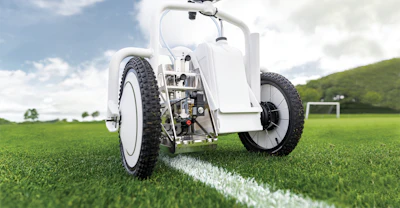

 Photo courtesy of Turf Tank
 Photo courtesy of TinyMobileRobots
 Photo courtesy of Turf Tank
 Photo courtesy of Turf Tank
 Photo courtesy of NGU Sports Lighting